Key Takeaways
- Hungarian ancestry can give language learning a personal purpose, from talking to relatives to understanding family stories and visiting ancestral towns.
- Hungarian can be challenging for English speakers, but unfamiliar grammar and vocabulary become more manageable through structured study and regular practice.
- Start with useful family vocabulary, accurate pronunciation, and simple sentences about who you are and where your relatives lived.
- Combine one structured course with speaking lessons, listening practice, and small family-history projects.
- Research ancestral place names carefully. A birthplace recorded as “Hungary” may now lie outside the country’s modern borders.
- Use a heritage trip to practise everyday conversations and explore your family’s background. Arrange archive visits and family meetings in advance.
- Distinguish between verifying existing Hungarian citizenship and applying for simplified naturalisation. These are different procedures with different language requirements.
- Your heritage is not a fluency test. Aim for meaningful conversations and steady progress rather than perfect Hungarian.
Learning Hungarian with Roots: How Your Ancestry Can Inspire Progress
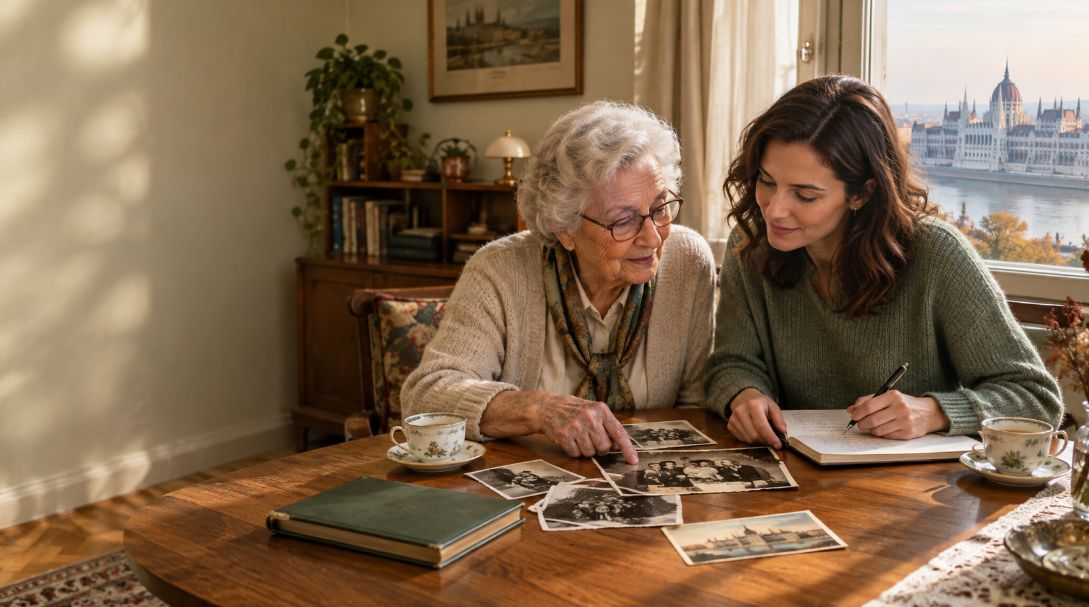
Your grandmother’s favourite expression. A surname nobody pronounces correctly. A postcard from a village you have never visited. For many Americans and Britons with Hungarian ancestry, learning Hungarian starts with something more personal than a holiday or a career move.
It starts with a missing connection.
Perhaps your family stopped speaking Hungarian after emigrating. Perhaps you heard it as a child but never learned to answer. Or perhaps your connection exists only in photographs, immigration documents, and stories that become less detailed with each generation.
Learning Hungarian offers a way to explore that history. It can help you speak with relatives, understand family documents, travel more independently, and build a more meaningful relationship with Hungary.
It will not make the grammar effortless. Ancestry does not give you an inherited ability to understand suffixes or pronounce unfamiliar vowels. What it can provide is motivation: a reason to return to the language when progress feels slow.
For heritage learners in the United States and United Kingdom, that personal reason can turn an intimidating project into a practical, rewarding journey.
Is Hungarian Really One of Europe’s Hardest Languages?
Hungarian has a formidable reputation among English speakers. Its vocabulary often looks unfamiliar, its grammar works differently from English, and even short sentences can contain words that seem surprisingly long.
There is a genuine reason for the adjustment. Hungarian belongs to the Uralic language family, rather than the Germanic, Romance, or Slavic families that dominate much of Europe.
That means English speakers cannot rely on the familiar vocabulary they might recognise when learning French, Spanish, or German.
However, “hardest” is not a universal ranking. Your experience depends on your first language, previous study, teaching methods, exposure, and goals.
The US State Department places Hungarian among languages with significant linguistic or cultural differences from English. Its intensive training estimates concern professional speaking and listening proficiency for government personnel. They are not deadlines for ordinary learners or predictions of how long it takes to order lunch or talk about your grandparents.
What Makes Hungarian Challenging?
English-speaking beginners usually encounter four major adjustments:
-
Unfamiliar vocabulary with fewer immediately recognisable words.
-
Suffixes that express relationships English often handles with separate words.
-
Vowel harmony, which influences the form of many endings.
-
Sentence structures that change according to emphasis and context.
The encouraging part is that Hungarian also contains learnable patterns. Spelling and pronunciation are relatively systematic, word stress normally falls on the first syllable, and grammatical gender does not create the same memorisation burden found in many other European languages.
The language becomes more manageable when you stop treating every unfamiliar feature as an exception.
Why Hungarian Ancestry Can Strengthen Your Commitment
Ancestry gives language learning a personal context.
A vocabulary list about family relationships is no longer an abstract classroom exercise when you want to describe your grandmother’s childhood. A lesson about locations becomes relevant when you are trying to explain where your great-grandfather lived.
This does not guarantee faster learning. Research on motivation among Hungarian learners supports the importance of personal, cultural, and practical goals, but it does not establish that ancestry automatically produces better results.
The useful advantage is more specific: family connections give you meaningful subjects to study and reasons to practise.
You Have Questions You Want Answered
Heritage learners often arrive with questions:
-
Where did my family live before emigrating?
-
Why did our surname change?
-
What does this phrase in an old letter mean?
-
Are there relatives still living in the region?
-
Which foods, traditions, or songs survived in our family?
These questions create small projects. Small projects make it easier to choose useful vocabulary and measure progress.
You Can Imagine a Real Conversation
“Become fluent” is a distant goal. “Introduce myself to my cousin in Hungarian” is concrete.
Picture a plausible first conversation:
You explain your name, where you live, who your grandparents were, and why you are learning. You understand a few questions. When you miss something, you ask the speaker to repeat it slowly.
That exchange may be short. It is still a substantial achievement.
You Do Not Need to Prove Your Identity Through Fluency
Ancestry motivation can become counterproductive if it turns into pressure.
Some learners feel embarrassed that they cannot speak a language associated with their surname or family history. Others believe they should learn faster because their grandparents spoke it.
Neither expectation is fair.
Language transmission can stop for many reasons: migration, schooling, mixed-language households, discrimination, displacement, or a family’s desire to help children integrate.
You are not correcting a personal failure. You are choosing to learn something that was not fully passed down to you.
Avoid making fluency a test of whether you are “Hungarian enough.” You can explore your heritage while speaking imperfectly, asking basic questions, and discovering that parts of the family story remain uncertain.
Start with Your Family Story, Not a Grammar Marathon
Before buying several courses, write down what you already know.
Create a simple heritage notebook containing:
-
Family surnames and spelling variations.
-
Given names, including Hungarian and English versions.
-
Birthplaces and approximate dates.
-
Known religions or denominations.
-
Migration dates and destinations.
-
Addresses, occupations, and family relationships.
-
Phrases, recipes, songs, and remembered expressions.
Separate confirmed information from assumptions. A family story is a valuable starting point, but it is not the same as a verified record.
Next, select one achievable language task. For example:
-
Introduce your family in six sentences.
-
Identify the birthplace on a certificate.
-
Write a short message to a relative.
-
Understand the ingredients in a family recipe.
-
Ask for directions in an ancestral town.
This keeps genealogy and language learning connected without allowing either project to become overwhelming.
Historical Hungary and Modern Borders: An Essential Distinction
A document stating that an ancestor came from “Hungary” does not necessarily mean the birthplace lies within Hungary’s current borders.
Historical place names and jurisdictions can differ significantly from modern ones. Your ancestral town may now be in Slovakia, Romania, Serbia, Ukraine, Croatia, Austria, or another present-day jurisdiction.
The Hungarian National Archives specifically emphasises the importance of identifying the correct place. Records may belong to an archive outside modern Hungary.
This matters for both research and travel.
Before planning a visit:
-
Identify the historical place name.
-
Confirm its modern name and location.
-
Establish the relevant civil registry or religious institution.
-
Check which archive holds the records.
-
Determine which languages appear in those records.
Do not assume every ancestor from historical Hungary spoke Hungarian as a first language. Historical communities were linguistically and culturally diverse.
Hungarian may help you understand your family’s background, but some documents could require Latin, German, or another regional language.
Learn Hungarian Pronunciation Early
Pronunciation deserves attention from the beginning. It affects whether people understand you and whether you recognise familiar words when someone else says them.
Start with recordings rather than relying entirely on English phonetic spellings.
Important distinctions include:
-
Hungarian “s” sounds roughly like English “sh.”
-
Hungarian “sz” corresponds roughly to English “s.”
-
“Cs” resembles the sound in “church.”
-
“Gy” and “ny” need focused listening and practice.
-
Short and long vowels must be distinguished.
Accents are not decoration. Vowel length can change meaning, and some vowel pairs also differ in quality.
For heritage learners, family names make useful pronunciation exercises. Ask a teacher to record your surnames and ancestral place names clearly.
Then practise them in sentences. Being able to say a village name alone is useful; being able to explain your connection to it is better.
Build Your First Vocabulary Around People and Places
You do not need to memorise every kinship term before having a conversation. Start with the people you actually discuss.
Learn these within useful sentences:
-
“Magyarul tanulok.” — I am learning Hungarian.
-
“Amerikában élek.” — I live in America.
-
“Angliában élek.” — I live in England.
-
“A nagymamám magyar volt.” — My grandmother was Hungarian.
-
“Szeretnék többet megtudni a családomról.” — I would like to learn more about my family.
Use a sentence only when it accurately describes your situation. Learners elsewhere in the UK should learn the appropriate location rather than using “England” as a substitute for the entire country.
Make Hungarian Grammar Relevant to Your Life
Hungarian grammar becomes less intimidating when you connect it to situations you recognise.
Take location:
-
Budapest: the city name.
-
Budapesten: in Budapest.
-
Budapestre: to Budapest.
-
Budapestről: from Budapest.
The endings carry information that English often expresses through separate words.
Instead of memorising every case ending at once, learn a small group through your travel plans and family history.
Practise sentences about:
-
Where you live.
-
Where your relatives live.
-
Where you are travelling.
-
Where your ancestor came from.
-
Who you are visiting.
Possession is another useful early topic. Family history naturally creates phrases such as “my grandmother,” “my grandfather’s name,” and “our family.”
Ask your teacher to build lessons around your actual story while still following a structured beginner syllabus.
Choose Resources That Work Together
A strong learning system does not require ten subscriptions. It requires complementary tools.
Use One Structured Course
Choose a course or textbook that teaches listening, speaking, reading, and grammar in a logical sequence.
MagyarOK is one established option, with associated digital practice available through Aktív MagyarOK. Try sample materials before committing, and check that the level suits your needs.
Use the course as your foundation rather than jumping between unrelated beginner lessons.
Add Regular Speaking Practice
A tutor can help you turn recognition into usable speech.
Explain your goals clearly:
-
Family conversations.
-
Heritage travel.
-
Reading basic records.
-
Everyday life in Hungary.
-
Citizenship-related communication, if relevant.
Ask for a balance of structured teaching and spontaneous conversation. A teacher who only rehearses a fixed family speech will not prepare you to understand unexpected questions.
Use Genealogy Tools for Specific Tasks
FamilySearch provides Hungarian genealogy guidance and digitised record collections. Its research material recommends identifying the ancestral town, locating the relevant records, and learning to interpret them.
You do not need conversational fluency to begin recognising recurring terms in birth, marriage, or death records.
However, reading a register and speaking with a relative are different skills. Practise both separately.
A Sustainable Weekly Routine for US and UK Learners
Consistency is more useful than an ambitious schedule you abandon after two weeks.
An illustrative weekly routine could include:
-
Four 20-minute sessions using your main course.
-
Two short listening sessions with repeated audio.
-
One tutor lesson.
-
One family-history task.
-
Brief spoken revision on most days.
This is a suggested framework, not a scientifically fixed formula.
During spoken revision, describe your day or family without looking at notes. Notice where you get stuck, then bring those gaps to your next lesson.
For American learners, the time difference with Hungary may make morning lessons convenient before work. UK learners often have more overlap with a Hungary-based teacher’s working day. Confirm scheduling around seasonal clock changes.
Most importantly, establish a minimum routine for busy weeks. Ten focused minutes can preserve continuity when a full lesson is unrealistic.
Turn a Hungary Visit into Language Practice
A heritage trip can make studying feel purposeful. It can also disappoint if you expect travel alone to create fluency.
Budapest is a practical starting point because it offers language programmes, cultural institutions, and opportunities to combine lessons with daily activities.
Balassi Summer University is one established option. Its programme combines intensive Hungarian study with cultural learning and activities in Budapest. Dates, fees, admission rules, and scholarship opportunities should be checked for the relevant intake.
A productive independent visit might combine:
-
Morning lessons.
-
A short daily speaking task.
-
A museum or neighbourhood visit.
-
Planned family research.
-
Time to review new vocabulary.
Do not schedule every day around demanding archive work. Research appointments, unfamiliar documents, and travel logistics can be tiring.
Practise Politely in Everyday Situations
Start with low-pressure exchanges in bakeries, shops, and cafés.
A useful phrase is:
“Tanulok magyarul. Beszélhetünk lassan?” — I am learning Hungarian. Can we speak slowly?
If someone switches to English, do not interpret it as rejection. They may be helping you or keeping a busy queue moving.
Seek dedicated practice through teachers, exchanges, and willing conversation partners rather than expecting service staff to provide a lesson.
Visiting Your Ancestral Town
A village visit often carries more emotional weight than a sightseeing day in Budapest.
Prepare a short explanation of who you are and why you have come. Bring copies of relevant names, dates, and addresses.
If contacting a local office, archive, religious institution, or potential relative:
-
Write ahead.
-
State your request clearly.
-
Ask whether an appointment is necessary.
-
Confirm language support.
-
Respect access rules and privacy.
-
Avoid arriving with expectations of immediate research assistance.
You may find a family house, a cemetery inscription, or a connection to a local community. You may also discover that records are missing or family stories need revising.
Both outcomes belong to honest heritage research.
Hungarian Citizenship: Know Which Route Applies
Ancestry and citizenship are related, but they are not interchangeable.
The Hungarian Embassy in Washington distinguishes between verifying existing Hungarian citizenship and applying for simplified naturalisation.
This distinction can change your language requirements.
Verification of Existing Citizenship
Some descendants may already be Hungarian citizens through descent, depending on the family’s legal history.
The embassy states that speaking Hungarian is not relevant to verification of existing citizenship. However, ancestry alone does not establish that every descendant qualifies. Documents and historical circumstances matter.
Simplified Naturalisation
Eligible applicants with qualifying ancestry may pursue simplified naturalisation. Hungarian-language ability is a requirement.
Do not assume that a DNA result, a Hungarian surname, or one ancestor’s certificate establishes eligibility. The relevant family relationship and legal conditions must be documented.
Likewise, avoid relying on commercial promises that a memorised interview script or a particular course level guarantees approval.
If citizenship is part of your motivation, ask the competent Hungarian consulate which procedure applies before building your study plan around it.
Common Mistakes Heritage Learners Can Avoid
Researching Forever Without Speaking
Genealogy can become a comfortable substitute for language practice. Keep researching, but make time to speak every week.
Collecting Resources Instead of Following a Course
Changing materials constantly creates repetition without progression. Use one main course long enough to see results.
Learning Only a Citizenship Script
A polished introduction is useful. It does not replace the ability to understand questions and respond naturally.
Expecting Relatives to Become Teachers
Relatives can provide conversation and family knowledge, but they may not enjoy correcting grammar. Agree on realistic expectations.
Treating Every Discovery as Proof
A matching surname or birthplace is a clue, not a confirmed family connection. Keep language learning separate from unsupported genealogical conclusions.
The Real Reward of Learning Hungarian with Roots
Ancestry cannot remove the work involved in learning Hungarian. You still need repetition, listening, feedback, and patience.
What it can do is make the work meaningful.
A grammar exercise becomes a way to explain where your family lived. A pronunciation lesson helps you say a relative’s name correctly. A short conversation gives you access to a memory that was previously out of reach.
Start with one family question, one structured course, and one manageable speaking goal. Build from there.
You do not need perfect Hungarian to begin reconnecting. You need enough language to take the next genuine step.
Frequently Asked Questions
Is Hungarian difficult to learn for English speakers?
Hungarian can be challenging because its vocabulary, suffixes, and sentence patterns differ considerably from English. However, difficulty depends on your goals and learning background. Start with pronunciation, useful phrases, and everyday conversations rather than trying to master the entire grammar system at once.
Can Hungarian ancestry help me learn the language?
Hungarian ancestry can give you a strong personal reason to keep studying. Speaking with relatives, understanding family expressions, or visiting an ancestral town can make lessons feel relevant. Your roots do not provide an inherited language ability, but they can help you stay interested when progress feels slow.
What is a Hungarian heritage learner?
A Hungarian heritage learner has a personal, family, or cultural connection to Hungarian. Some heard the language at home as children but rarely spoke it. Others begin as complete beginners after discovering Hungarian ancestry. You do not need previous knowledge of the language to start exploring that connection.
Where should I start if I want to learn Hungarian because of my family roots?
Start with pronunciation, family vocabulary, and a short introduction about yourself. Learn to explain where you live, who your Hungarian relatives were, and why you are studying. Combine one structured beginner course with regular speaking practice, then add vocabulary connected to your family research.
How long does it take to learn enough Hungarian to speak with relatives?
There is no reliable timeline that applies to everyone. Your progress depends on study frequency, speaking practice, previous experience, and the complexity of the conversation. Set a practical first goal: introduce yourself, describe your family, ask simple questions, and request slower speech. These skills are more achievable than an undefined goal of “fluency.”
Can learning Hungarian help me research my family history?
Yes. Basic Hungarian can help you recognise names, occupations, relationships, and recurring terms in historical records. However, documents connected to historical Hungary may also use Latin, German, or other languages. Identify your ancestor’s town and the relevant record collection before deciding which language skills or specialist help you need.
Does a Hungarian birthplace mean my ancestor came from modern-day Hungary?
Not necessarily. Historical Hungary covered territory beyond the country’s current borders. A town recorded under a Hungarian name may now be in a neighbouring country. Confirm its modern name, location, and archive jurisdiction before planning research or a heritage trip.
Can I study Hungarian during a heritage trip to Budapest?
Yes. You can combine lessons with family research, cultural activities, and everyday speaking practice. Balassi Summer University is one established programme that combines Hungarian-language instruction with cultural studies in Budapest. Check future intake dates, eligibility, fees, and funding directly with the organiser.
Do I need to speak Hungarian to obtain citizenship through ancestry?
It depends on the procedure. Verification establishes whether you already hold Hungarian citizenship and does not require Hungarian-language ability. Simplified naturalisation requires Hungarian-language knowledge, alongside qualifying ancestry and other conditions. Ask the relevant Hungarian consulate which route applies before choosing a citizenship-focused language course.
Do I need fluent Hungarian to reconnect with my heritage?
No. You can begin by learning family names, understanding a remembered phrase, reading a simple message, or introducing yourself to relatives. Language ability can deepen that connection over time, but it is not a test of your identity. Focus on meaningful progress rather than perfect speech.
Sources
Research and official guidance informing this article include language-training information, Hungarian genealogy resources, cultural study programmes, and consular citizenship guidance.state+6
- US Department of State — Foreign Language Training and Learning Timelines
- Why Hungarian? — Research on Hungarian Language Learners’ Motivations
- National Archives of Hungary — Family Research Guidance
- FamilySearch — Hungarian Genealogy Research Resources
- Aktív MagyarOK — Beginner Hungarian Lessons and Practice
- Balassi Summer University — Hungarian Language and Cultural Studies
- Embassy of Hungary in Washington — Hungarian Citizenship and Language Requirements