Key Takeaways
- Budapest is an ideal European city-break destination for UK and US travellers, combining historic architecture, Danube views, thermal baths, excellent food, museums, cafés and lively nightlife.
- For a first visit, stay three nights if possible. This gives you enough time for the Hungarian Parliament, Buda Castle, Fisherman’s Bastion, Matthias Church, the Chain Bridge, St Stephen’s Basilica, the Jewish Quarter and at least one thermal bath.
- The city’s standout experience is its spa culture. Choose Széchenyi for iconic outdoor pools, Gellért for Art Nouveau surroundings, Rudas for Ottoman history and rooftop views, or Lukács for a quieter local feel.
- The best times for a Budapest weekend break are late spring and early autumn, when temperatures are generally comfortable for sightseeing and crowds are lighter than the peak summer months. Summer is livelier but can be hot; winter is colder but perfect for Christmas markets and steaming outdoor thermal baths.
- Budapest works well as the starting or finishing point of a Central European trip. Vienna is around 2.5–3 hours away by direct train, Bratislava is an easy day trip from Vienna, and Prague can be reached by direct rail in roughly 6.5–7 hours.
- For a simple first itinerary, spend one day in central Pest and along the Danube, one day on Castle Hill and at the baths, and a third day exploring City Park, the Central Market Hall, museums or the Jewish Quarter.
- Budapest offers the most rewarding experience when you leave space for unplanned café stops, evening river walks, panoramic viewpoints and relaxation—not just landmark-hopping.
Budapest City Breaks: Attractions, Thermal Baths and Weekend Itineraries
A Budapest city break is one of Europe’s most rewarding short escapes: dramatic Danube views, grand architecture, thermal baths, café culture, nightlife and excellent connections to Vienna, Bratislava and Prague. For UK and US travellers, the Hungarian capital works equally well as a long weekend destination or as the first stop on a wider Central European itinerary.
Budapest, capital of Hungary feels larger and more varied than a typical weekend city. The Buda side brings hills, castles and panoramic viewpoints; Pest delivers the Parliament, elegant boulevards, museums, markets, cafés and nightlife. Spend three nights if you can, four if you want to include slower bathing, neighbourhood exploration or a day trip. Two nights are enough for the essentials, but not enough to understand why so many visitors return.
Why Budapest Works So Well
Budapest is divided by the Danube, with historic, hilly Buda on the western bank and flatter, more energetic Pest on the eastern side. The city’s visual appeal comes from that contrast. One day may include a walk through medieval lanes beneath Buda Castle, followed by sunset across the river, a grand café in Pest and a thermal bath after dark.
It is also a city with layers. Roman remains, Ottoman-era bathing culture, Habsburg grandeur, Jewish heritage, Art Nouveau façades, Communist-era history and contemporary food-and-drink culture all sit within a relatively compact visitor area.
For UK visitors, Budapest remains an accessible European weekend break with frequent air links, a manageable time difference and a strong value proposition compared with several Western European capitals. For US visitors, it is often a highlight of a longer multi-city journey through Central Europe: distinctive enough to stand on its own, yet well connected by rail to Vienna, Bratislava and Prague.
Budapest’s official tourism information highlights the city’s unusually rich thermal-bath heritage and identifies Parliament, the Danube riverfront and major historic sights among its signature experiences.
Essential Budapest Attractions
Hungarian Parliament Building
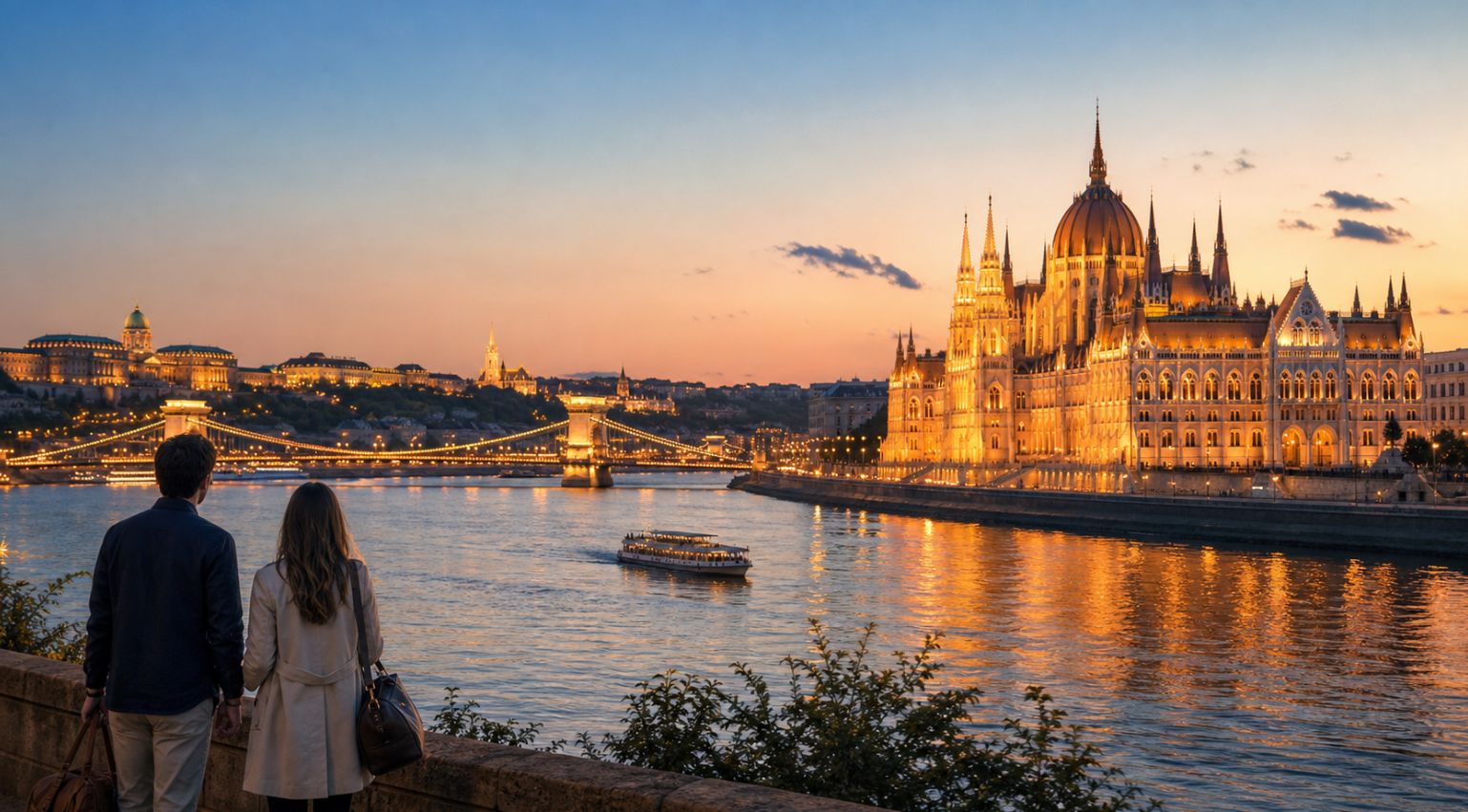
The Hungarian Parliament Building is Budapest’s visual anchor. Its neo-Gothic façade runs along the Pest-side Danube bank, and its riverside position makes it especially impressive from Buda, from a Danube cruise or during an evening walk.
Book an interior tour in advance if you want to see the grand staircase, ceremonial halls and the Hungarian Holy Crown. Even if you do not go inside, set aside time to view the building from several angles:
- Across the river from Batthyány tér on the Buda side.
- From Fisherman’s Bastion and Castle Hill.
- From the Danube promenade around sunset.
- From a river cruise after dark, when the façade is illuminated.
The Parliament building is not simply a photo stop. It is also Hungary’s legislature and a major symbol of national identity, standing on the Danube bank within Budapest’s World Heritage landscape.
Buda Castle and Castle Hill
Castle Hill is the historic heart of Buda. Its cobbled streets, palace complex, old townhouses, museums and viewpoints make it ideal for a slow half-day rather than a rushed checklist visit.
Buda Castle has been rebuilt and reshaped many times, reflecting the city’s turbulent past. Today, the wider complex and district are as important as any single room inside it. Walk around the Royal Palace area, explore the elevated streets and pause at the terraces overlooking Pest.
The Hungarian National Gallery and Budapest History Museum are useful options for visitors who want cultural context or need an indoor plan during bad weather. Castle Hill is particularly beautiful in early morning, late afternoon and after dark, when the riverfront panorama becomes more dramatic.
Fisherman’s Bastion and Matthias Church
Fisherman’s Bastion is one of Budapest’s most recognisable viewpoints. Its white stone towers, stairways and terraces were built in a romantic, neo-Romanesque style rather than as a functioning medieval fortification. From here, you look directly across the Danube toward Parliament, the Chain Bridge and the Pest skyline.
It can be crowded from late morning onward, especially between May and September. Go early, visit close to sunset, or simply return after dark for a quieter and more atmospheric experience.
Beside it stands Matthias Church, a richly decorated landmark with a distinctive patterned-tile roof. The combination of church, terraces, cobbled streets and river views makes this one of the most photogenic areas of Budapest.
Széchenyi Thermal Bath
No Budapest city break is complete without experiencing its thermal-bath culture. Budapest is widely described as a spa city, and official tourism information notes that no other capital has as many thermal baths.
Széchenyi Thermal Bath, in City Park, is the famous first choice for many visitors. Its neo-Baroque buildings, outdoor steaming pools and social atmosphere make it especially memorable in cool weather. Winter bathing—when warm water meets cold air—has become one of Budapest’s signature travel experiences.
However, Széchenyi is not the only option. Choose a bath based on the kind of experience you want:
Bath rules, opening hours, age restrictions, swimsuit requirements and services can change, so check the official operator information before visiting. If you are travelling during a busy weekend, consider booking where advance tickets are available and arrive earlier in the day.
St Stephen’s Basilica
St Stephen’s Basilica is one of Pest’s grandest religious buildings, with a striking dome and a central location near cafés, shops and elegant streets. The square outside is a good place to pause between sightseeing stops.
Climbing or taking the lift to the dome viewpoint is worthwhile on a clear day. You get a different perspective from Castle Hill: a city-centre panorama of rooftops, boulevards and the Danube rather than the classic Buda-to-Pest view.
The basilica also hosts concerts, which can be a memorable evening option for visitors who want something more formal than bars or a cruise.
The Chain Bridge and Danube Promenade
The Széchenyi Chain Bridge is Budapest’s best-known bridge and an emblem of the city. It links the historic Buda and Pest sides at a point where the riverfront is at its most dramatic.
Walk across it at least once. Start in Pest around St Stephen’s Basilica or Vörösmarty Square, cross toward Castle Hill, then return along the Danube promenade. The views are best around sunset, but daytime allows clearer photographs of Buda Castle and the hills.
The Danube promenade also leads to the Shoes on the Danube Bank memorial, a moving Holocaust memorial commemorating victims murdered on the riverbank during the Second World War. Visit respectfully; this is not a place for posed photographs.
Jewish Quarter and Dohány Street Synagogue
Budapest’s Jewish Quarter, centred around District VII, is one of the city’s most dynamic areas. It combines Jewish heritage sites, street art, independent shops, coffee houses, restaurants and the city’s best-known ruin bars.
The Dohány Street Synagogue is a major landmark and one of the largest synagogues in Europe. Its wider complex includes memorial spaces and a museum that help visitors understand the history of Budapest’s Jewish community and the Holocaust in Hungary.
Allow time to explore respectfully rather than treating the district only as a nightlife zone. A guided walking tour can be particularly useful here, as it provides historical context that is easy to miss when walking independently.
Central Market Hall and Hungarian Food
The Central Market Hall near Liberty Bridge is a good introduction to Hungarian ingredients, market culture and souvenir shopping. Visit in the morning for the liveliest atmosphere, then walk along nearby Váci Street or toward the riverside.
Traditional dishes worth trying include goulash soup, chicken paprikash, stuffed cabbage, lángos, chimney cake and seasonal pastries. Budapest is also increasingly strong for speciality coffee, modern Hungarian cooking, vegetarian dining and international cuisine.
For an easy first evening, choose a traditional restaurant in central Pest. For a more local-feeling meal, move beyond the main tourist streets into Districts V, VI, VII, VIII or IX—after checking recent reviews and opening hours.
The Best Things to Do in Budapest
Budapest is a city where experiences matter as much as landmarks. The following activities work especially well for a two-, three- or four-day visit.
Take a Danube cruise
A short Danube cruise is one of the easiest ways to understand Budapest’s geography. You see Parliament, Castle Hill, the Chain Bridge, Liberty Bridge and the riverside skyline without navigating between viewpoints on foot.
Daytime cruises are useful for orientation and photography. Evening cruises are better for atmosphere, especially when the bridges and monumental buildings are illuminated. Choose a simple sightseeing cruise if you want value, or a dinner cruise if the experience itself is the priority.
Ride the historic metro and explore Andrássy Avenue
Budapest’s Millennium Underground, commonly known as Metro Line 1, runs beneath Andrássy Avenue and is one of the oldest underground railways in continental Europe. It is a practical way to connect central Pest with Heroes’ Square and City Park.
Walk part of elegant Andrássy Avenue above ground, then continue to Heroes’ Square. From there, explore City Park, where you will find Széchenyi Bath, Vajdahunyad Castle, green space and seasonal activities.
Visit a ruin bar—then explore beyond them
Ruin bars began as improvised venues in abandoned or semi-derelict buildings, especially around the Jewish Quarter. Szimpla Kert is the best known and worth seeing once for its unusual rooms, mismatched furniture and creative atmosphere.
But Budapest nightlife is broader than its ruin bars. Look for wine bars, cocktail bars, jazz venues, craft-beer spots and quieter courtyard restaurants depending on your preferences. A long weekend can become tiring if every evening is built around the busiest party streets, so balance nightlife with a thermal bath, concert or riverside walk.
Explore Margaret Island or the Buda Hills
For green space, go to Margaret Island in the Danube or head into the Buda Hills. Margaret Island works well for a gentle walk, jog, rented bike or summer picnic. The Buda Hills offer wooded trails and more expansive views for visitors who want a break from central-city crowds.
These are especially enjoyable in late spring and early autumn. In midsummer, visit in the morning or later in the afternoon to avoid the hottest part of the day.
See Budapest after dark
Budapest is arguably at its most cinematic after sunset. Parliament, Buda Castle, bridges and the Danube embankment are beautifully lit, and the city remains walkable in the central areas.
A simple evening route is:
- Begin around St Stephen’s Basilica.
- Walk to the Danube promenade.
- View the illuminated Buda Castle across the river.
- Cross the Chain Bridge or take a riverside tram.
- End at Fisherman’s Bastion for a night-time panorama.
When to Visit Budapest
Budapest has four distinct seasons. The best time depends on whether you prioritise weather, festivals, lower prices, Christmas markets, thermal-bath atmosphere or fewer crowds.
Spring: March to May
Spring is one of the best seasons for a Budapest city break. March can still feel cool, but April and May bring longer days, outdoor terraces, blossom in parks and comfortable sightseeing temperatures.
Late April through June is often a sweet spot: warm enough for walking and outdoor dining, but usually less intense than peak July and August. Travel guidance commonly identifies spring and early autumn as the most balanced periods for pleasant weather and lighter crowds.
Spring is ideal for:
- First-time sightseeing.
- Danube walks and cruises.
- Castle Hill and City Park.
- Cafés and terrace dining.
- Long weekends that avoid the busiest summer period.
Summer: June to August
Summer is Budapest at its liveliest. Days are long, outdoor events are frequent, rooftop bars and riverside terraces are busy, and the city has a festival feel. It is also the warmest, most crowded and often most expensive period.
July and August can be hot, sometimes uncomfortably so for all-day walking. Build your itinerary around early starts, a midday museum or bath break, and evening sightseeing. Book popular attractions and accommodation well in advance for major weekends and festival periods.
Summer is best for:
- Outdoor dining and nightlife.
- Danube cruises after dark.
- Festivals and concerts.
- City Park, Margaret Island and riverfront walks.
- Combining Budapest with other Central European cities.
Autumn: September to November
September and early October are arguably the best months for many visitors. The heat eases, daylight remains generous, restaurants and terraces are still active, and the city is generally more comfortable for walking than in midsummer.
Autumn colours improve parks, Castle Hill and the Buda Hills. It is also an excellent season for food-focused travel, wine events and relaxed cultural itineraries.
Go in September or early October if you want:
- Pleasant temperatures without peak-season intensity.
- Better conditions for walking and photography.
- A more relaxed city-break pace.
- Easier hotel availability than high summer.
Winter: December to February
Budapest in winter is cold but highly atmospheric. Thermal baths become particularly appealing, while Christmas markets, festive lights and grand coffee houses create a cosy city-break mood.
December is popular for holiday travel, especially around Christmas and New Year, so prices and demand can rise. January and February are quieter and may offer better hotel value, although days are shorter and outdoor sightseeing requires warm clothing.
Winter is best for:
- Thermal-bath experiences.
- Christmas markets and festive dining.
- Museums, cafés and concerts.
- Lower-season travel outside the festive peak.
- A romantic weekend break with less pressure to sightsee all day.
Budapest Weekend Itineraries
Two nights: the essential first visit
A two-night Budapest break should focus on the city’s essentials rather than trying to see every district.
Day one: Explore Pest—St Stephen’s Basilica, Parliament from outside, the Danube promenade, the Chain Bridge and an evening cruise.
Day two: Visit Castle Hill, Fisherman’s Bastion and Matthias Church, then relax at a thermal bath. Finish with dinner in the Jewish Quarter or a concert near the basilica.
This itinerary is compact, scenic and manageable even for first-time visitors.
Three nights: the ideal long weekend
Three nights give you time to slow down.
Day one: Central Pest, Parliament, Basilica and a Danube cruise.
Day two: Castle Hill, Fisherman’s Bastion, Buda Castle and a thermal bath.
Day three: Heroes’ Square, City Park, Széchenyi Bath or Vajdahunyad Castle, then the Jewish Quarter, Central Market Hall or a food tour.
This is the most balanced option for a UK city break. It covers Budapest’s major highlights while leaving enough time for café stops, unplanned walks and an unhurried evening.
Four nights: Budapest plus a day trip
With four nights, you can add Margaret Island, a Buda Hills walk, a museum, a wine tasting or a day trip. This is also the best length if Budapest is part of a broader Vienna–Bratislava–Prague itinerary.
Combining Budapest With Vienna, Bratislava and Prague
Budapest is often the eastern or southern anchor of a Central European multi-city trip. Vienna, Bratislava and Prague each offer a different atmosphere:
Budapest and Vienna
Budapest and Vienna are a particularly strong pairing. Vienna is more formal, imperial and museum-focused; Budapest is more dramatic, relaxed and bathing-centred. Together, they offer a satisfying contrast.
ÖBB states that direct train connections between Vienna and Budapest run every hour. The journey is typically around 2.5 to 3 hours depending on the service, so the route is practical for a multi-city itinerary.
A sensible route is:
- Fly into Budapest, stay three nights.
- Take the train to Vienna, stay two or three nights.
- Continue to Bratislava for a day or overnight stay.
- Travel onward to Prague, then fly home.
Vienna and Bratislava
Bratislava is one of the easiest capital-city additions in Europe. It is compact, walkable and less demanding than Vienna, Prague or Budapest. Its Old Town, castle and Danube setting can be covered comfortably in a day, though an overnight stay offers a more relaxed pace.
Vienna and Bratislava are connected by frequent rail services, with journeys around an hour. The seasonal Twin City Liner boat offers a more scenic Danube alternative between the capitals.
For most travellers, Bratislava works best as:
- A day trip from Vienna.
- A one-night stop between Vienna and Budapest.
- A quieter break in a busy multi-city route.
Budapest and Prague
Prague and Budapest are often compared, but they deliver very different trips. Prague is compact, intensely historic and visually concentrated around the Old Town, Charles Bridge and Prague Castle. Budapest is more spread out, more varied in mood and defined by the Danube, baths and the Buda–Pest contrast.
Direct rail travel is possible, although it takes longer than the Budapest–Vienna route. Typical direct journeys are roughly 6.5 to 7 hours, depending on the train and timetable.
If your time is limited, flying may be more convenient. If you enjoy train travel, consider making the journey part of the experience, perhaps stopping in Bratislava or Vienna rather than travelling directly.
Practical Budapest City-Break Tips
-
Stay central: District V is ideal for first-time visitors who want Parliament, the Danube and major sights nearby. District VI offers an elegant central base. District VII is convenient for nightlife and restaurants but can be noisy. Buda is quieter, hillier and better for views than late-night city energy.
-
Use public transport: Budapest’s metro, trams and buses are useful and affordable. Validate or use the correct ticket format, and check current ticket rules before travel.
-
Carry a card and some forints: Hungary uses the Hungarian forint, not the euro. Card payments are common, but small cash can still be convenient.
-
Book headline sights: Parliament tours, some thermal-bath slots, popular cruises and special restaurants can sell out during busy weekends.
-
Plan around Sundays and holidays: Opening hours vary, especially for markets, museums and smaller businesses.
-
Respect local history: The Shoes on the Danube Bank memorial, Holocaust sites and other remembrance spaces deserve quiet, respectful visits.
-
Avoid overpacking the schedule: Budapest is best enjoyed with time for views, cafés, baths and spontaneous neighbourhood walks.
Final Verdict
Budapest is one of Europe’s best city-break destinations because it combines iconic architecture, accessible culture, thermal relaxation, good food and a genuinely distinctive atmosphere. It can be glamorous without feeling overly formal, historic without becoming museum-like and lively without requiring a nightlife-centred trip.
For a first visit, choose three nights and focus on Parliament, Castle Hill, Fisherman’s Bastion, the Danube, a thermal bath and the Jewish Quarter. Travel in late spring or early autumn for the best balance of weather, crowds and city life. Add Vienna for imperial grandeur, Bratislava for an easy capital-city detour and Prague for a longer, architecture-rich Central European adventure.
Whether you visit for a romantic weekend, a friends’ escape, a solo city break or the start of a rail itinerary, Budapest has enough depth to reward both first-time visitors and repeat travellers.
Budapest City Break FAQs
Is Budapest good for a weekend break?
Yes. Budapest is an excellent choice for a two- or three-night European city break because many of its headline sights are close together: Parliament, the Danube promenade, St Stephen’s Basilica, the Chain Bridge, Castle Hill and the Jewish Quarter can all be explored within a compact central area.
For a first trip, three nights is ideal. It gives you time for the main attractions, a thermal bath, a Danube cruise, good food and a slower evening walk without turning the break into a rushed sightseeing schedule.
How many days do you need in Budapest?
Two full days are enough for the essential sights, but three full days provide a much better balance of sightseeing and relaxation.
A practical first-time itinerary is:
- Day one: Parliament, St Stephen’s Basilica, the Danube promenade, Chain Bridge and an evening Danube cruise.
- Day two: Buda Castle, Fisherman’s Bastion, Matthias Church and a thermal bath.
- Day three: City Park, Heroes’ Square, the Central Market Hall, the Jewish Quarter, museums or a food tour.
Stay four nights if you want to explore neighbourhoods at a slower pace, add Margaret Island or the Buda Hills, or take a Central European day trip.
What are the must-see attractions in Budapest?
The key Budapest attractions include the Hungarian Parliament Building, Buda Castle, Fisherman’s Bastion, Matthias Church, St Stephen’s Basilica, the Chain Bridge, the Danube promenade, Heroes’ Square, the Central Market Hall and the Dohány Street Synagogue area.
Budapest is also famous for thermal bathing. Official tourism information describes the city as a spa capital and highlights its exceptional concentration of historic thermal baths.
Which thermal bath is best in Budapest?
The best Budapest thermal bath depends on the atmosphere you want.
Széchenyi is the classic first choice, particularly in autumn and winter when the outdoor thermal pools are at their most memorable. Check the official bath website before visiting, as opening times, booking rules and access to individual pools can change.
When is the best time to visit Budapest?
Late spring—especially April, May and early June—and early autumn, particularly September and early October, are generally the best times for a Budapest city break. These periods tend to offer comfortable weather for walking, outdoor dining and sightseeing, without the peak heat and crowds of midsummer.
Summer is best for outdoor events, nightlife and long evenings by the Danube, but July and August can be hot and busy. Winter is colder, yet it is ideal for Christmas markets, museum visits, cafés and steaming outdoor thermal baths.
Is Budapest expensive for UK and US visitors?
Budapest can offer good value compared with several major Western European capitals, particularly for public transport, casual dining, cafés and some cultural activities. However, the city is not a bargain in every category: central hotels, popular bath tickets, high-end restaurants, river cruises and peak-weekend travel can be expensive.
Your costs depend heavily on season, how early you book, hotel location, dining style and whether you choose tourist-focused attractions every day. For better value, book accommodation and headline attractions in advance, use public transport, and explore restaurants beyond the busiest riverfront and party-street locations.
Is Budapest safe for tourists?
Budapest is generally considered a manageable and popular city for independent travellers, but the usual big-city precautions apply. Keep belongings secure in crowded areas, on public transport and around nightlife districts; use licensed taxis or reputable ride-hailing services; and be cautious of unsolicited invitations to bars, clubs or overpriced venues.
At night, central tourist areas are typically busy, but it is sensible to stay aware of your surroundings, especially after drinking. In an emergency, dial 112, the Europe-wide emergency number.
Is Budapest walkable?
Yes, especially in central Pest. District V, the Danube promenade, St Stephen’s Basilica, Parliament, Váci Street and much of the Jewish Quarter can be explored on foot.
Buda is hillier. Castle Hill involves slopes, steps and cobbled lanes, although public transport and the funicular can reduce walking. Budapest’s trams and metro are useful when travelling between Pest, Castle Hill, City Park and outer neighbourhoods.
Can I use euros in Budapest?
Hungary’s official currency is the Hungarian forint (HUF). Some tourist businesses may accept euros, but exchange rates can be poor, and it is better not to rely on euro cash for everyday purchases.
Cards are widely accepted in Budapest. Carrying a small amount of forints can still be useful for minor purchases, markets or situations where card payment is unavailable. Check your bank’s foreign-transaction fees and choose to pay in forints rather than accepting an unfavourable dynamic-currency-conversion rate when offered.
Is Budapest good for food and nightlife?
Yes. Budapest has a broad dining scene that includes traditional Hungarian restaurants, modern Central European cooking, cafés, bakeries, speciality coffee shops, wine bars, cocktail bars and international restaurants.
For classic Hungarian dishes, look for goulash soup, chicken paprikash, stuffed cabbage, lángos and chimney cake. The Jewish Quarter is known for restaurants and nightlife, including ruin bars such as Szimpla Kert. It is lively and entertaining, but visitors looking for a quieter evening may prefer the riverside, the Basilica area, wine bars or neighbourhood restaurants in Districts V, VI, VIII or IX.
Is Budapest better than Prague?
Neither city is objectively better; they suit different travel styles.
Prague is more compact and immediately fairy-tale-like, with Gothic spires, Charles Bridge, Old Town Square and Prague Castle concentrated around a very walkable historic core. Budapest feels larger, more varied and more dramatic because of the Danube, the contrast between Buda and Pest, its thermal baths and its broader mix of architecture and neighbourhoods.
Choose Prague if you want a compact, architecture-led first Central European city break. Choose Budapest if you want landmark sightseeing combined with thermal bathing, nightlife, cafés, river views and a wider sense of city life.
Can I visit Vienna from Budapest?
Yes. Vienna is one of the easiest and most rewarding add-ons to a Budapest trip. Direct Railjet and EuroCity services connect Budapest and Vienna regularly, and ÖBB states that there is a service every hour between Vienna and Budapest.
The fastest Budapest–Vienna rail journeys take around 2 hours 25 minutes, and direct services run daily.
For most travellers, Vienna deserves at least two nights. A day trip is possible, but it can feel rushed once train time, museum visits and walking are included.
Can I visit Bratislava from Budapest?
Yes, but Bratislava is usually easiest to combine with Vienna rather than attempting it as a quick day trip from Budapest. Vienna and Bratislava are very close, with rail journeys of around one hour, making Bratislava a convenient half-day, full-day or overnight stop.
A good Central European route is Budapest → Vienna → Bratislava → Prague. This avoids unnecessary backtracking and gives each city the right amount of time.
Can I travel from Budapest to Prague by train?
Yes. Direct trains are available between Budapest and Prague, but the journey is substantially longer than the Budapest–Vienna route. Expect roughly 6.5 to 7 hours for many direct services, depending on the timetable and operator.
The train is a good choice if you enjoy overland travel and have time to spare. If you have a short itinerary, consider splitting the journey with a stop in Vienna or Bratislava, or compare rail with flights based on your exact dates.
What is the best area to stay in Budapest?
For a first-time city break, District V is the most convenient base. It is central to Parliament, the Danube, St Stephen’s Basilica, the Chain Bridge and many restaurants.
- District V: Best overall for first-time visitors, sightseeing and river access.
- District VI: Central, elegant and well connected, with Andrássy Avenue nearby.
- District VII: Best for nightlife, food and the Jewish Quarter; choose carefully if you are sensitive to late-night noise.
- Castle District / Buda: Best for quieter evenings, historic charm and views; less convenient for nightlife and some Pest attractions.
- District IX: Good for a more local-feeling stay, food markets and modern riverside areas.
What should I book in advance in Budapest?
Book ahead for Parliament tours, popular thermal baths, Danube dinner cruises, major concerts, top-rated restaurants and centrally located hotels on busy weekends.
For a smooth long weekend, reserve the time-sensitive attractions first—especially Parliament and any bath or cruise that has a fixed entry slot—then build the rest of your itinerary around them.
Sources
- Budapestinfo: Top sights in Budapest
- Lonely Planet: Best time to visit Budapest
- ÖBB: Travelling to Budapest by train
- ÖBB: Rail timetable
- Trainline: Budapest to Vienna train times
- Vienna Spirit: Bratislava day trip from Vienna
- ACP Rail: Budapest to Prague train tickets
- Rail.cc: Budapest to Prague by train