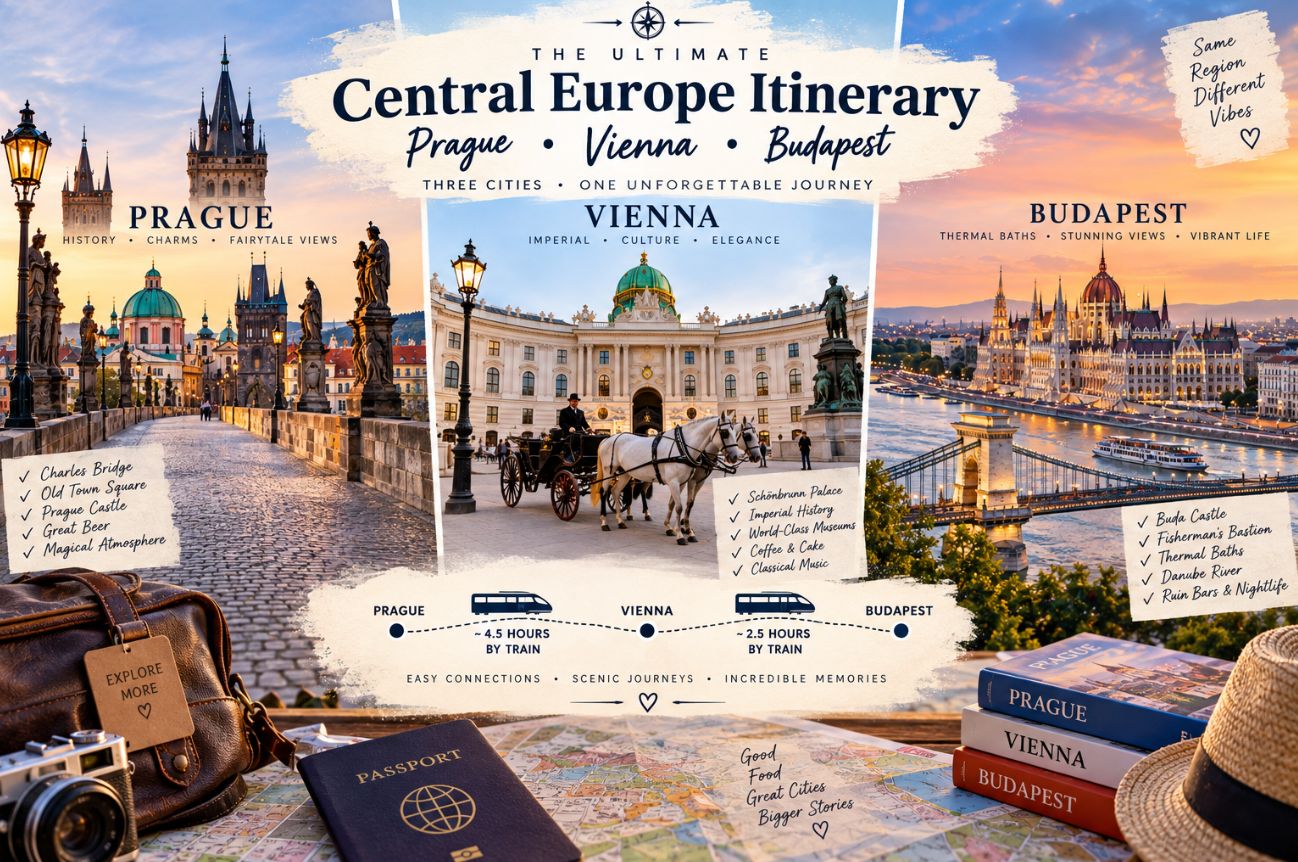
A 7-day Prague–Vienna–Budapest itinerary
- A 7-day Prague–Vienna–Budapest itinerary is one of the easiest and most rewarding Central Europe city-break routes, combining Gothic Prague, imperial Vienna and relaxed, riverfront Budapest.
- The recommended split is:
- Days 1–2: Prague
- Days 3–4: Vienna
- Days 5–7: Budapest
- Start in Prague with Charles Bridge, Old Town Square, the Astronomical Clock, Prague Castle and the cobbled lanes of Malá Strana. Enjoy a traditional pub meal and a locally brewed Czech pilsner.
- Travel from Prague to Vienna by direct train on Day 3. The journey normally takes just over four hours, making it practical to arrive before lunch and still enjoy a full afternoon in Vienna.
- In Vienna, see St Stephen’s Cathedral, walk the historic centre, experience a traditional coffee house, eat Wiener schnitzel and visit the Hofburg or Schönbrunn Palace. A classical concert is a fitting final-night experience.
- Take the direct train from Vienna to Budapest on Day 5; the journey generally takes around 2.5 hours, so you can reach Budapest in time for an evening Danube walk or cruise.
- In Budapest, see the Hungarian Parliament Building at night, visit the Shoes on the Danube Bank memorial, explore Buda Castle and Fisherman’s Bastion, and relax in Széchenyi Thermal Bath.
- On your final Budapest day, browse the Great Market Hall for Hungarian food and souvenirs, then visit the Jewish Quarter and Szimpla Kert for the city’s iconic ruin-bar atmosphere.
- Book intercity trains and timed attractions in advance, especially in summer and during holidays. Keep your passport, cards and electronics with you on trains, not in unattended luggage.
- Fly into Prague and home from Budapest where possible. This open-jaw flight plan avoids retracing your route and gives you more time in the cities.
Central Europe City Breaks: The Best 7-Day Prague, Vienna and Budapest Itinerary
A seven-day trip through Central Europe is one of Europe’s most satisfying multi-city breaks. The classic Prague–Vienna–Budapest route combines three dramatically different capitals in one efficient rail journey: Prague brings Gothic spires, beer halls and Bohemian atmosphere; Vienna offers imperial palaces, coffee houses and classical music; Budapest closes the trip with Danube views, thermal baths and a nightlife scene that feels entirely its own.
For US and UK travellers, this itinerary is particularly practical. The cities are linked by direct trains, English is widely used in tourism, and the route moves naturally from north to south: begin in Prague, continue to Vienna, then finish in Budapest. You avoid backtracking, experience three countries in a week, and leave the most relaxed city for last.
The best version is simple:
- Days 1–2: Prague, Czechia
- Days 3–4: Vienna, Austria
- Days 5–7: Budapest, Hungary
This is not an itinerary for seeing every museum or every neighbourhood. It is a well-paced introduction to three major European capitals, with enough time for signature sights, local food, evening atmosphere and unplanned discoveries.
Planning note: Train times, routes, attraction access, border requirements and opening hours can change. Book key train journeys and major attractions in advance, then reconfirm practical details before you travel. This itinerary assumes a standard leisure trip with two nights in Prague, two nights in Vienna and three nights in Budapest.
Why Prague, Vienna and Budapest Work So Well
Prague, Vienna and Budapest once belonged to overlapping Central European political, cultural and commercial worlds. Today, they remain connected by the Danube corridor, Habsburg history, rail infrastructure, café traditions and a shared architectural richness—yet each has a sharply distinct personality.
Prague feels romantic, medieval and creative. Its compact historic core rises around the Vltava River, Charles Bridge and Prague Castle. Vienna is more formal and polished, built around imperial ambition, music, grand boulevards and coffee-house culture. Budapest feels bolder and more relaxed: a city of hills and riverbanks, parliamentary grandeur, historic baths and inventive nightlife.
The route is efficient because the travel legs are manageable:
That timing means your travel days are not lost days. Leave Prague after breakfast, arrive in Vienna in time for lunch and an afternoon walk. Do the same from Vienna to Budapest, then spend the evening on the Danube.
For a seven-day Central Europe itinerary, that rhythm is ideal. Prague gets two focused days, Vienna gets two days including its palaces and music, and Budapest receives three days because it is the best city on the route for slowing down.
Before You Go
For US and UK passport holders, Czechia, Austria and Hungary are all in the Schengen Area. Short tourist travel is generally limited to 90 days in any rolling 180-day period across the entire Schengen zone. Check passport-validity rules, entry conditions and any travel-authorisation developments before booking.
A few practical decisions will make the journey much easier:
- Book open-jaw flights if possible: fly into Prague and fly home from Budapest.
- Reserve Prague–Vienna and Vienna–Budapest train tickets before travel, especially for weekends, holidays and summer.
- Keep your passport, cards and valuables with you on trains rather than in overhead luggage.
- Use a card with low foreign-transaction fees, but keep a small amount of local currency in each country.
- Download offline maps for Prague, Vienna and Budapest.
- Pack comfortable shoes; all three cities reward walking, but Prague’s cobbles and Buda’s hills are demanding.
- Bring a Type C or F European plug adapter. US visitors should ensure devices support 230V; UK visitors normally only need the plug adapter.
- Book major timed attractions in advance, especially Prague Castle circuits, Schönbrunn Palace, Parliament tours and popular thermal baths.
Days 1–2: Prague, Czechia
Prague is the most immediately theatrical city on this itinerary. Its historic centre feels built for wandering: Gothic church towers, Baroque façades, cobbled lanes, bridges and river views appear within a relatively compact area.
The key to enjoying Prague is timing. See Charles Bridge early, before the crowds; enjoy Old Town Square after dark; and leave time to wander Malá Strana, where the city becomes quieter, more residential and more atmospheric.
Day 1: Charles Bridge, Old Town and the Astronomical Clock
Start early at Charles Bridge. This landmark connects Prague’s Old Town with Malá Strana and is one of the city’s essential experiences. Prague City Tourism places it at the heart of the historic connection between Staré Město and Malá Strana.prague+1
At sunrise, the bridge feels less like a tourist corridor and more like what it really is: a grand 14th-century crossing with views toward Prague Castle, the Vltava River and the city’s spires. If you visit later in the day, expect street performers, artists, tour groups and crowds.
Cross from the Malá Strana side toward Old Town, or reverse the route depending on where you are staying. Either way, make time to look outward rather than simply photographing the bridge itself.
Continue to Old Town Square, Prague’s historic centre of gravity. The square is surrounded by richly coloured buildings, Gothic towers and lively cafés. Its famous Astronomical Clock, mounted on the Old Town Hall, performs its mechanism on the hour; watch it once, but do not feel compelled to build your whole day around it. The square itself is the main experience.
Afterward, explore the lanes around Old Town. Wander toward the Jewish Quarter, browse independent shops, stop for coffee and avoid the temptation to eat every meal directly on the busiest square. A short walk away can make a significant difference in price and atmosphere.
For lunch or dinner, try a traditional Czech pub meal:
- Svíčková, marinated beef with creamy sauce and dumplings.
- Goulash with bread or potato dumplings.
- Roasted pork with cabbage.
- Fried cheese, a casual Czech classic.
- A local pilsner beer, if you drink alcohol.
Czech beer culture is part of the Prague experience, but the best approach is not a rushed drinking challenge. Order a well-kept local pilsner in a traditional pub, pair it with food and enjoy the slower rhythm.
End Day 1 with Old Town after sunset or a relaxed river walk. Prague’s lit skyline is particularly beautiful at night, and the crowds thin out slightly once day visitors leave.
Day 2: Prague Castle and Malá Strana
Day 2 belongs to Prague Castle and the elegant streets of Malá Strana.
Prague Castle is not simply one building; it is a vast complex of courtyards, churches, palaces and historic structures above the city. The outer grounds and public areas are generally open daily, while interior monuments follow separate opening times and ticket rules.
Arrive early. Begin with St Vitus Cathedral, whose Gothic architecture dominates the castle skyline. Then explore the courtyards and viewpoints before deciding which interior circuit is most worth your time.
You do not need to see every room. For a seven-day multi-city trip, focus on:
- St Vitus Cathedral.
- The castle courtyards and city views.
- Golden Lane, if it interests you.
- The walk down toward Malá Strana.
- A pause at a viewpoint over Prague’s red roofs.
From the castle, walk down into Malá Strana, also known as the Lesser Town. This is one of Prague’s most enjoyable neighbourhoods: elegant, Baroque, calmer than Old Town and full of side streets that reward curiosity.
See St Nicholas Church, walk around Kampa Island and consider a stop at the Lennon Wall. Then return toward Charles Bridge in late afternoon, when the city is shifting into evening.
Prague’s strength is its walkability. Avoid filling Day 2 with too many paid attractions. The route from Castle Hill through Malá Strana to the river is the experience.
Days 3–4: Vienna, Austria
Vienna is a change of pace. After Prague’s medieval density, the Austrian capital feels grander, more ordered and more ceremonious. Its centre is defined by imperial buildings, broad streets, refined cafés and a musical tradition that still shapes the city’s identity.
Take an early train from Prague on Day 3. The journey is typically around four hours, so you should arrive in time to drop bags, have lunch and begin exploring central Vienna.
Day 3: St Stephen’s Cathedral, Coffee Houses and Central Vienna
Start in the historic centre at Stephansplatz, where St Stephen’s Cathedral rises above the surrounding streets. The cathedral is one of Vienna’s defining landmarks, with a distinctive patterned tile roof and a central position that makes it easy to incorporate into a walking route.
The cathedral also remains part of Vienna’s active musical life. Vienna’s official visitor information notes that St Stephen’s Cathedral hosts concerts, including seasonal performances of Vivaldi’s The Four Seasons.
After visiting the exterior and, if desired, the interior or tower, walk through the surrounding pedestrian streets. Explore Graben, Kohlmarkt and the streets around the Hofburg complex.
Vienna’s centre is made for deliberate wandering. Do not treat it as a shopping district alone. Look up at the façades, notice the courtyards and allow time for a coffee-house break.
A classic Vienna coffee-house stop is more than a caffeine break. Order coffee, sit down and do not rush. Try a slice of Sachertorte, apple strudel or another local pastry, but remember that famous cafés can be busy and expensive. The experience is worth having once; subsequent coffee breaks can be chosen more spontaneously.
For lunch, order Wiener schnitzel. A true Wiener schnitzel is traditionally made with veal, though many restaurants also offer pork versions. Pair it with potato salad, parsley potatoes or a simple side salad.
In the afternoon, visit the Hofburg area. The former imperial palace complex offers museums, courtyards, ceremonial spaces and a direct connection to the Habsburg dynasty. You do not need to see every museum to appreciate its scale. Even walking through the surrounding imperial district gives you a sense of Vienna’s historical role as a European power centre.
Finish Day 3 with an evening concert, wine bar or relaxed dinner. Vienna offers classical performances across the city, from major concert halls to churches and palace venues. Official Vienna tourism guidance highlights beginner-friendly concert options featuring Mozart and Strauss, often held at prominent venues.
Choose carefully. Some concert experiences are designed heavily for tourists and can feel formulaic. A short concert in a beautiful setting can still be enjoyable, but check the programme, performers, duration, reviews and venue before booking.
Day 4: Schönbrunn Palace and Imperial Vienna
Day 4 should focus on Schönbrunn Palace, the Habsburgs’ former summer residence. The complex provides the most complete introduction to imperial Vienna: gilded rooms, formal gardens, grand views and the sense of scale expected from a dynasty that shaped Central Europe for centuries.
Book a timed palace entry in advance. The most popular times sell out, especially from late spring through early autumn.
A good Schönbrunn plan includes:
- A morning palace tour.
- Time in the formal gardens.
- A walk up to the Gloriette for a view back toward the palace and across Vienna.
- Lunch or coffee after the main visit.
- A slower afternoon in the Museum Quarter, Naschmarkt or another neighbourhood.
Do not try to combine Schönbrunn, the Hofburg, Belvedere, the Albertina and every central museum in a single day. Vienna is best when you leave breathing space between grand interiors.
If your interests lean toward art, choose the Belvedere for Klimt’s The Kiss. If you prefer city life, spend the afternoon around Naschmarkt or in a traditional coffee house. If you want another historical layer, return to the Ringstrasse and explore by tram or on foot.
Spend your final Vienna evening somewhere memorable. A classical concert fits naturally with the city’s identity, but so does a quiet dinner with Austrian wine. Vienna does not need to be rushed; its appeal lies in ritual, detail and atmosphere.
Days 5–7: Budapest, Hungary
Budapest is the ideal final stop because it feels more open, more energetic and more restorative after two days of city sightseeing in Vienna. The Danube, Buda hills, thermal water and late-night dining culture create a more relaxed finish.
The direct Vienna–Budapest train usually takes around 2.5 hours, making Day 5 an easy transfer day. Arrive by early afternoon, check in and begin with the river—the city’s natural introduction.
Day 5: Danube Views and Parliament at Night
After arriving in Budapest, walk toward the Danube promenade. Budapest’s landscape makes immediate sense from the riverbank: Buda Castle rises on one side, Parliament dominates the Pest side and bridges link the two halves of the city.
Start near the Chain Bridge, then walk north along the Pest embankment toward the Hungarian Parliament Building. The building is spectacular by day but even better after dark, when it is illuminated beside the water.
If time permits, pause at the Shoes on the Danube Bank memorial near Parliament. The cast-iron shoes commemorate Jewish victims murdered on the riverbank during the Second World War. It deserves a quiet and respectful visit rather than a rushed photograph.
A Danube cruise is an excellent first-night activity, particularly at sunset or after dark. It helps orient you and offers views that are difficult to recreate from the street.
For dinner, choose a central Pest restaurant or wine bar rather than eating immediately on the busiest tourist strip. Try goulash, chicken paprikash, duck, Hungarian wine or a lighter modern-Hungarian menu depending on your mood.
Day 6: Buda Castle, Fisherman’s Bastion and Széchenyi Bath
Begin Day 6 on the Buda side.
Visit the Buda Castle District, climbing Castle Hill on foot, by bus or via the historic funicular. The castle complex includes museums, courtyards and some of the city’s best river views. Continue toward Matthias Church and Fisherman’s Bastion, the neo-Romanesque terrace whose towers create one of Budapest’s iconic skyline scenes.
From Fisherman’s Bastion, Parliament appears directly across the Danube. Visit early if you want clearer photographs and fewer crowds. The view is especially good in the morning, while the terraces are quieter.
After lunch, make your way to Széchenyi Thermal Bath in City Park. This is one of Budapest’s defining experiences: a grand thermal complex with outdoor pools, indoor facilities and an unmistakable Central European atmosphere. The official bath site describes Széchenyi as one of Europe’s largest and oldest thermal-bath complexes.
Book ahead if travelling on a weekend, holiday or summer afternoon. Bring swimwear, flip-flops and a towel or plan to rent one. Do not rush: the point is to spend time in the warm water after a day of walking.
Gellért Thermal Bath has historically been another famous option, but it is closed for renovation and is expected to reopen in 2028.
For dinner, head back toward central Pest or explore a calmer Buda neighbourhood. After a bath day, many travellers prefer a quiet meal and an early evening rather than another packed schedule.
Day 7: Great Market Hall, Jewish Quarter and Ruin Bars
Spend the final morning at the Great Market Hall near Fővám tér. It is a useful place to see Hungarian food culture, try snacks and buy practical souvenirs.
Look for:
- Paprika.
- Salami.
- Local honey and preserves.
- Tokaj wine.
- Hungarian sweets.
- Lángos, fried dough usually served with toppings such as sour cream and cheese.
The market is popular with visitors, so not every item is inexpensive or uniquely local. Treat it as a place to browse, taste and buy a few well-chosen edible souvenirs rather than as a bargain-hunting mission.
In the afternoon, explore the Jewish Quarter. The area around Kazinczy utca, Dohány Street and nearby lanes has cafés, restaurants, historic sites, boutiques, street art and much of Budapest’s contemporary energy.
If you are interested in Jewish history, allow time for the Dohány Street Synagogue and its surrounding memorial spaces. If food and nightlife are your priority, save your appetite for the evening.
Finish the trip with Budapest’s signature nightlife experience: the ruin bars. These bars occupy converted courtyards and worn-in old buildings, filled with mismatched furniture, visual clutter, music and cultural programming.
Szimpla Kert, on Kazinczy utca 14, is the best-known ruin bar and a useful first stop. Its official site lists food, drinks, programmes and cultural activity, while its long history has made it one of Budapest’s defining nightlife venues.szimpla+1
Go early if you want to appreciate the strange, inventive décor. Go later if you want a livelier crowd. Either way, use normal city-travel caution: keep valuables secure, watch your drinks and do not follow strangers to unknown venues.
Where to Stay
For this itinerary, stay central enough to walk in the evenings, but not necessarily on the loudest square.
Prague
Choose Old Town, New Town, Malá Strana or Vinohrady depending on your preference. Old Town is convenient but crowded and expensive; Malá Strana is atmospheric and quieter at night; Vinohrady feels more residential and local.
Vienna
The Innere Stadt is the easiest location for a short first visit, though it is often expensive. Neubau, Mariahilf, Leopoldstadt and Wieden can provide better value while remaining well connected.
Budapest
District V is ideal for Parliament, the Danube and central sights. District VI offers easy access to Andrássy Avenue and central Pest. District VII is lively and convenient for nightlife but can be noisy. District XI and District XIII can be good choices for a more residential feel and strong transport links.
Money, Trains and Travel Tips
This route crosses three countries with three currencies:
Use official bank ATMs where possible, decline dynamic currency conversion if prompted, and select payment in the local currency. Avoid exchange kiosks at airports or street-level operators with unclear rates.
For train travel:
- Book direct services when available.
- Reserve seats for Prague–Vienna and Vienna–Budapest in busy periods.
- Arrive early enough to find the correct platform.
- Keep passports, money and electronics in a small bag on your person.
- Save train tickets offline in case mobile data fails.
- Bring water and snacks, particularly for the Prague–Vienna journey.
- Do not leave luggage unattended at stations.
Final Verdict: The Best Way to See Central Europe in One Week
A Prague–Vienna–Budapest route is one of the strongest seven-day European itineraries for travellers who want history, architecture, food, culture and nightlife without wasting days on long travel connections.
Prague gives you medieval drama and easy walking. Vienna delivers imperial history, classical music and café culture. Budapest brings the Danube, thermal baths and a more relaxed, social finish. Together, they show how varied Central Europe can be.
The trick is not to overfill the week. Walk Charles Bridge at sunrise, take time for coffee in Vienna, soak in a Budapest thermal bath and leave each city with one free evening. That balance turns a fast multi-country itinerary into a trip that feels rich rather than rushed.
Top 10 FAQs: Prague, Vienna and Budapest in 7 Days
Is seven days enough for Prague, Vienna and Budapest?
Yes, seven days is enough for a well-paced first introduction to all three capitals, although you will not see every museum, palace or neighbourhood. A strong split is two days in Prague, two days in Vienna and three days in Budapest, with Budapest receiving an extra day for its thermal baths, Danube walks and more relaxed pace.
What is the best order for a Prague, Vienna and Budapest trip?
The most efficient route is usually Prague → Vienna → Budapest. It moves in one direction through Central Europe, avoids backtracking and lets you use convenient rail connections between the cities. Consider booking an open-jaw flight: arrive in Prague and fly home from Budapest.
Can I travel from Prague to Vienna and Budapest by train?
Yes. Train travel is the most practical way to connect the three cities. The Prague-to-Vienna trip generally takes around four to four-and-a-half hours, while Vienna to Budapest is usually about two-and-a-half hours by direct train.omio+1
Should I book Central Europe train tickets in advance?
Yes, particularly for Friday and Sunday departures, summer, Christmas markets, Easter, school holidays and popular morning trains. Booking in advance often gives you better fares and a seat reservation. Keep tickets downloaded offline, arrive at the station early and carry passports, cards and electronics in a small bag on your person.
Do US and UK travellers need visas for Prague, Vienna and Budapest?
For short tourist trips, US and UK citizens can generally visit the Schengen Area—including Czechia, Austria and Hungary—without a visa for up to 90 days in any rolling 180-day period. This is one shared allowance across the entire Schengen Area, not 90 days per country.travel.state+2
Do I need my passport when travelling between the three cities?
Yes. Although Czechia, Austria and Hungary are all Schengen countries and routine internal border checks are generally absent, travellers should carry their valid passport at all times. Authorities can conduct temporary or targeted checks, and hotels, transport providers or police may request identification.
What are the top attractions in Prague, Vienna and Budapest?
In Prague, see Charles Bridge, Old Town Square, the Astronomical Clock, Prague Castle and Malá Strana. In Vienna, visit St Stephen’s Cathedral, the Hofburg, Schönbrunn Palace, traditional coffee houses and a classical concert. In Budapest, prioritise Parliament, the Danube, Buda Castle, Fisherman’s Bastion, Széchenyi Thermal Bath, the Great Market Hall and the Jewish Quarter.
What currencies do Prague, Vienna and Budapest use?
Prague uses the Czech koruna (CZK), Vienna uses the euro (€) and Budapest uses the Hungarian forint (HUF/Ft). Cards are widely accepted in all three cities, but carry a small amount of local cash for markets, small purchases and occasional cash-only businesses. Always choose to pay in the local currency rather than accepting card-terminal conversion to pounds or US dollars.
Which city is best for nightlife, food and relaxation?
Budapest is the strongest all-round final stop for nightlife and relaxation. It has Danube-view bars, food markets, wine bars and the famous ruin-bar scene around the Jewish Quarter, while its thermal-bath culture provides a distinctive way to unwind after a week of sightseeing. Prague is ideal for traditional pubs and pilsner, while Vienna is best for coffee houses, pastries, refined dining and classical music.
What should I pack for a Central Europe city-break itinerary?
Pack comfortable walking shoes, a light waterproof layer, a European plug adapter, a portable charger, a secure cross-body bag, refillable water bottle and clothes that work for both casual sightseeing and a concert, restaurant or nicer bar. In autumn and winter, bring warmer layers; Prague’s cobbled streets, Vienna’s long walking routes and Budapest’s riverfront can feel colder than expected.
Sources
- Prague City Tourism: Official Visitor Information
- Vienna Tourist Board: Church Concerts and St Stephen’s Cathedral
- Vienna Tourist Board: Classical Concerts for Beginners
- Hungarian Parliament: Official Visitor Information
- Széchenyi Thermal Bath: Official Website
- Gellért Thermal Bath: Official Renovation Update
- Szimpla Kert: Official Website