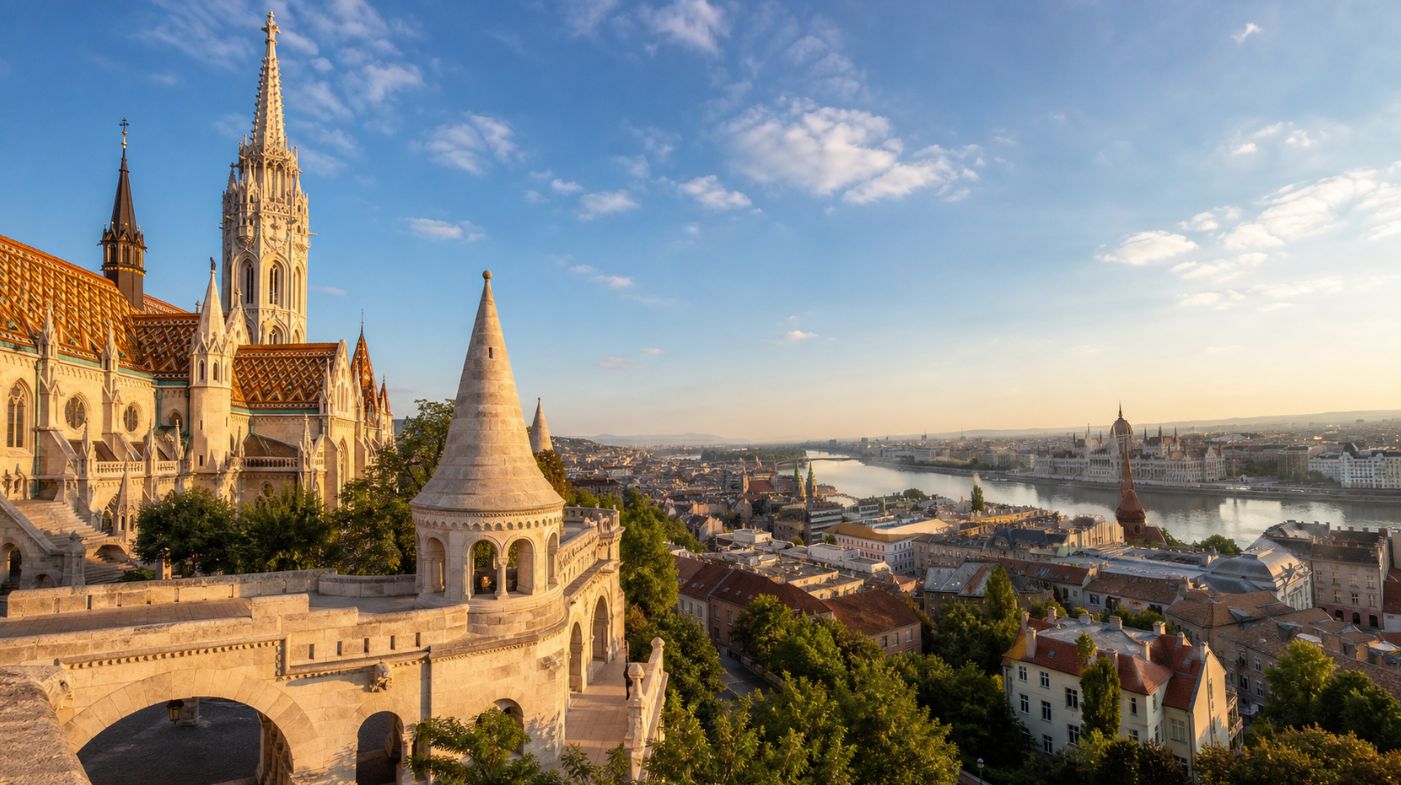
Buda Castle of Hungary is not simply one attraction on a Budapest itinerary; it is the historic heart of the Buda side of the city. Rising above the Danube, its royal courtyards, medieval lanes, skyline views and landmark buildings offer the most atmospheric way to understand Budapest’s past and present.
For UK visitors, the Buda Castle District is an easy place to fall in love with. It feels markedly different from the grand boulevards and café culture of Pest: quieter in the early morning, more elevated in every sense, and layered with centuries of Hungarian history. A visit can be as brief as a photo stop at Fisherman’s Bastion or as immersive as a full day exploring Buda Castle, Matthias Church, Castle Hill museums and the surrounding cobbled streets.
The district is part of the UNESCO-listed Budapest panorama, which includes the Danube banks, Buda Castle Quarter and Andrássy Avenue. UNESCO describes it as an outstanding urban landscape shaped by successive historical periods, from medieval Buda through the city’s later development as a major Central European capital.
First Impressions of Buda Castle
Approaching Buda Castle from the Pest side of the Danube is genuinely impressive. The long palace complex stretches across Castle Hill, crowned by its recognisable green dome and framed by the Chain Bridge, the river and the city’s layered skyline. It is one of those views that makes Budapest immediately feel like a capital built for grand entrances.
Yet Buda Castle is more nuanced once you arrive. Rather than a single intact medieval fortress, it is a substantial historic complex that has changed dramatically over the centuries. Royal residences, Gothic foundations, Baroque rebuilding, wartime destruction and later reconstruction have all left their mark. This is why the castle is best appreciated not as a perfectly preserved palace but as a living architectural record of Hungary’s changing fortunes.
The area began developing as a fortified royal centre after King Béla IV built the castle of Buda on the rocky spur following the Mongol invasion of 1241–42. Over time, Buda became a key centre of the Hungarian monarchy and a major artistic influence in the region, especially during the reign of Matthias Corvinus. That historical weight is present even when you are simply walking through the courtyards.
For many travellers, however, the real magic lies north of the main palace at Holy Trinity Square. Here, Matthias Church and Fisherman’s Bastion create Budapest’s most recognisable fairytale skyline. Their proximity makes them ideal to visit together, but each has a very different character: one is an extraordinarily significant church with a turbulent history, the other a romantic panorama terrace designed to celebrate Hungary’s past.
Buda Castle: Royal History and Views
The modern appearance of Buda Castle is largely Baroque, with a broad and stately profile rather than the vertical Gothic drama people may expect from a medieval fortress. Its current form reflects repeated destruction and rebuilding, particularly after the Ottoman period and the Second World War. This complex history is part of the appeal: every era has made an architectural contribution.
The exterior is rewarding even for visitors who do not enter a museum. Wander around the castle courtyards and terraces to find monumental gateways, fountains, sculptures and sweeping Danube views. The elevated location means that the Parliament Building, Chain Bridge and Pest’s historic centre often appear in the background, creating some of the most memorable Budapest photographs.
Buda Castle is also home to major cultural institutions, including the Hungarian National Gallery and the Budapest History Museum. These make the hill a strong option on a rainy day or for travellers who want more than exterior sightseeing. The recently restored St Stephen’s Hall, meanwhile, can be visited through pre-booked guided access, adding a more intimate royal-palace perspective to the experience.
What stands out most is the contrast between the palace’s grandeur and the small-scale streets around it. Leave the main castle terraces and the mood changes quickly. Narrow lanes, residential façades, quiet squares and old city walls make the Castle District feel more like a historic town than a conventional tourist attraction. This is the reason to allow time beyond the headline sights.
The castle’s setting also helps explain Budapest itself. From Castle Hill, you can see how Buda’s hilly terrain faces Pest’s flatter, more formal cityscape across the Danube. The river does not divide two unrelated halves; it connects two historical identities. The Chain Bridge, completed in 1849, became a powerful symbol of that connection, while the formal unification of Buda, Pest and Óbuda followed in 1873.
Matthias Church: Budapest’s Coronation Church
Matthias Church, or Mátyás-templom in Hungarian, is the visual and historical star of Holy Trinity Square. Officially known as the Church of the Assumption of the Buda Castle, it is one of Budapest’s most distinctive buildings, instantly recognisable for its tall Gothic spire and colourful patterned roof tiles.
The church is often called the Coronation Church of Buda, an appropriate title given its royal associations. Construction was underway by 1247, and the building has witnessed medieval ceremonies, royal weddings, Ottoman occupation, coronations and wartime damage. It is not a static monument; it is a building that has repeatedly adapted to political and religious change.
King Matthias Corvinus is the figure most strongly associated with the church, which is why it became known as Matthias Church. He attended a solemn thanksgiving Mass there after his election as king in 1458, and he married both Catherine of Podebrady in 1463 and Beatrice of Aragon in the church in 1476. His coat of arms can still be seen on the south-western wall of the tower, a small but meaningful reminder of the king’s connection to the site.
The church’s history was not always peaceful. When Suleiman the Magnificent occupied Buda in 1541, the Church of Our Lady was converted into a mosque. Following the Christian reconquest of Buda in 1686, it returned to Catholic use, though subsequent rebuilding and a damaging fire in 1723 altered the building further. These changes help explain why the church contains layers rather than one untouched medieval interior.
The 19th-century restoration led by architect Frigyes Schulek gave Matthias Church much of the form visitors recognise today. Restoration began in 1873, and the renovated church was consecrated in 1896. Schulek’s work was not merely decorative: he sought to recover and interpret the building’s Gothic identity, producing a vision that feels historical but is also closely tied to the national revival of late 19th-century Hungary.
Inside, Matthias Church is more colourful and ornate than its pale-stone exterior suggests. Decorative painted walls, vaulted ceilings, stained glass and richly patterned surfaces create an almost theatrical atmosphere. Visitors should look beyond the obvious photo opportunities and take time to notice the painted motifs, side chapels and memorials. The church holds the tombs of King Béla III and his wife, Anne of Châtillon, who were ceremonially reburied there in 1898.
The building also occupies a central place in modern Hungarian history. Franz Joseph and Elisabeth were crowned King and Queen of Hungary here in 1867, following the Austro-Hungarian Compromise. Charles IV and Zita were later crowned at Matthias Church in 1916, in what became the last coronation of a Hungarian king.
For a visitor, this depth of history makes Matthias Church far more than a beautiful backdrop to Fisherman’s Bastion. It is an active place of worship, a royal monument and one of the most important architectural experiences in Budapest. If you visit during a concert, the Gothic surroundings can make the experience feel particularly special, although it is always worth checking official opening times and service schedules before planning your visit.
Fisherman’s Bastion: Budapest’s Best Panorama
If Matthias Church provides the history, Fisherman’s Bastion provides the fantasy. The white-stone arches, stairways, turrets and terraces of Halászbástya look as though they belong in a storybook, with postcard views over the Danube and across to the Hungarian Parliament Building.
Despite its medieval appearance, Fisherman’s Bastion is relatively modern. It was built between 1895 and 1902 in a Neo-Romanesque style, designed by Frigyes Schulek, the same architect responsible for the restoration of Matthias Church. Its purpose was not military defence. Rather, it was conceived as a viewing terrace and architectural setting that would enhance the church and celebrate Hungary’s historic identity.
The name comes from the medieval fishermen’s guild, which was traditionally responsible for defending this stretch of Buda’s city walls. It is a charming detail that adds character to the site, although visitors should not expect a rough fortress or a museum of fishing history. What you see today is primarily an elegant, decorative belvedere built above older defensive walls.
The seven pointed towers are the Bastion’s defining feature. They symbolise the seven Magyar chieftains associated with the Hungarian tribes that entered the Carpathian Basin in 895. Whether viewed from below or from the adjoining square, the towers frame Budapest’s skyline in a way that feels deliberately cinematic.
The panorama is the main reason to visit. From Fisherman’s Bastion, you can see the Danube curving through the capital, the Parliament’s Gothic Revival silhouette, the bridges connecting Buda and Pest, and the immense spread of the city beyond. It is particularly rewarding in the softer light of early morning, around sunset or after dark, when the Parliament and riverfront are illuminated.
For photographers, the practical recommendation is simple: arrive early. During the middle of the day, Fisherman’s Bastion can be crowded with walking tours, couples, school groups and photographers. Early morning gives you the best chance of quieter arches, cleaner compositions and a more contemplative experience. Evening can also be excellent, but expect more people.
Fisherman’s Bastion can be enjoyed without treating it as a checklist attraction. Sit under an arch, look across the river and notice the different textures of Budapest: the wooded hills behind you, the historic quarter under your feet and the grand urban panorama in front. It is one of the rare viewpoints where the city’s geography becomes immediately understandable.
Holy Trinity Square and the Castle District
Matthias Church and Fisherman’s Bastion stand beside Holy Trinity Square, or Szentháromság tér. It is a compact square, but one loaded with character. The Holy Trinity Column at its centre is a Baroque monument, while the colourful roof of Matthias Church and pale arches of Fisherman’s Bastion make the surrounding architecture unusually photogenic.
This is the part of Budapest where it pays to slow down. Rather than rushing straight from a bus stop to a viewpoint, take time to walk the surrounding streets. The Castle District has a more residential rhythm than central Pest, especially away from the main attractions. Look for quiet courtyards, old façades, small galleries and glimpses towards the Buda Hills.
The wider Buda Castle Quarter reflects both medieval and Baroque urban forms, a contrast UNESCO identifies as an important characteristic of the historic district. This mixture is visible in the streetscape: medieval origins may lie beneath the surface, while many visible buildings present later façades and rebuilding campaigns.
A well-planned walking route starts at the lower castle area, continues towards Buda Castle’s courtyards, then follows the hill north to Matthias Church and Fisherman’s Bastion. This creates a natural progression from royal architecture to religious history and finally to Budapest’s best-known panorama. If you are arriving from Pest, the historic Buda Castle Funicular offers a scenic route up from the Chain Bridge area, though buses and walking routes may suit other itineraries better.
Is Buda Castle Worth Visiting?
Yes – particularly if it is your first visit to Budapest. Buda Castle, Matthias Church and Fisherman’s Bastion form an essential cluster of Budapest landmarks, but they are more rewarding than a standard “top sights” list suggests. Together, they explain why the city feels so visually dramatic: hills, river, royal history and monumental architecture all meet in one walkable area.
The main caveat is expectation. Buda Castle is not a compact palace interior with one clear visitor route, and Fisherman’s Bastion is very popular. Visitors who expect an untouched medieval castle or total tranquillity at midday may be disappointed. Visitors who approach the district as a historic urban landscape, rather than a single attraction, will get much more from it.
For UK travellers used to historic European cities, the Castle District may recall elements of Prague, Vienna or Edinburgh, but it still feels distinctly Hungarian. The colourful roof of Matthias Church, the Neo-Romanesque theatricality of Fisherman’s Bastion and the views of the Parliament across the Danube are unmistakably Budapest.
It is also worth returning at different times. Morning reveals the architecture and a calmer atmosphere; late afternoon brings warmer light; evening turns the riverfront into a glittering cityscape. Few places in Budapest reward repeat visits as reliably as Castle Hill.
Practical Tips for Visiting
-
Allow at least three to four hours for Buda Castle, Matthias Church and Fisherman’s Bastion if you want to explore without rushing.
-
Visit Fisherman’s Bastion early for the best chance of quieter views and photographs.
-
Wear comfortable shoes. Castle Hill includes cobbled surfaces, slopes and stairs, even if you arrive by funicular or bus.
-
Check official websites before visiting for current church services, concert programmes, admission arrangements, guided-tour availability and temporary closures.
-
Combine indoor and outdoor sights. Visit Matthias Church or a castle museum alongside the terraces so the experience remains worthwhile in less favourable weather.
-
Respect the setting. Matthias Church is an active religious site, and the Castle District is also a residential area, not just an open-air attraction.
Final Verdict
Buda Castle District is one of the best places to begin a Budapest city break because it delivers history, architecture and views in equal measure. The royal palace grounds offer scale and context; Matthias Church adds spiritual and national history; Fisherman’s Bastion supplies the unforgettable Danube panorama.
If you only have one morning in Buda, make it this one: explore Buda Castle, walk through Holy Trinity Square, step inside Matthias Church and finish beneath the arches of Fisherman’s Bastion. It is iconic Budapest, but it earns that status.
FAQs: Buda Castle, Matthias Church and Fisherman’s Bastion
Is Buda Castle worth visiting?
Yes. Buda Castle is one of Budapest’s essential sights, combining royal history, panoramic Danube views, museum collections and easy access to Matthias Church and Fisherman’s Bastion. Allow at least half a day to explore the Castle District at a relaxed pace.
Is there an entrance fee for Buda Castle?
You can walk around much of the Buda Castle complex, its courtyards and the wider Castle District free of charge. However, individual attractions inside or around the palace—such as museums, exhibitions and St Stephen’s Hall—normally require separate admission. Check official websites for current prices and opening arrangements before your visit.
Is Fisherman’s Bastion free to visit?
The lower terraces and many of the outdoor areas at Fisherman’s Bastion are generally free to access. Some upper viewing areas may require a ticket during busier periods, so confirm the current access rules before visiting.
What is Fisherman’s Bastion famous for?
Fisherman’s Bastion, known locally as Halászbástya, is famous for its seven fairytale-style towers and spectacular views across the River Danube towards the Hungarian Parliament Building. Built between 1895 and 1902, its towers represent the seven Magyar chieftains associated with the settlement of Hungary.
Why is it called Fisherman’s Bastion?
The name refers to the medieval fishermen’s guild, which was traditionally responsible for defending this section of Buda’s city walls. Although it resembles a fortress, the current Fisherman’s Bastion was designed primarily as a decorative viewing terrace rather than a functioning military fortification.
Is Matthias Church free to enter?
Matthias Church is an active place of worship, but sightseeing access usually requires an admission ticket. Opening hours can change for religious services, concerts, private events and restoration work, so check the official Matthias Church website before travelling.
Why is Matthias Church important?
Matthias Church, or Mátyás-templom, is one of Hungary’s most historically important churches. Construction was underway by 1247; it has served as a coronation church, been used as a mosque during Ottoman rule and hosted the 1867 coronation of Franz Joseph and Elisabeth as King and Queen of Hungary.
How do I get to Buda Castle from central Budapest?
Popular options include walking up Castle Hill, taking Bus 16 from Deák Ferenc Square, or travelling by the Buda Castle Funicular from the Chain Bridge area. The funicular reaches the Royal Palace area, while Bus 16 provides useful access from both the Pest and Buda sides.
What is the best time to visit Fisherman’s Bastion?
Early morning is usually best for quieter views, clearer photographs and a more relaxed atmosphere. Sunset and evening are also excellent for seeing the Danube, Chain Bridge and Parliament illuminated, although these periods can be busier.
How long do you need at Buda Castle?
Allow around three to five hours for Buda Castle, Matthias Church, Fisherman’s Bastion and a walk around the Castle District. Plan a full day if you also want to visit a museum, take a guided tour or explore the lesser-known streets and viewpoints.
Can you visit Buda Castle and Fisherman’s Bastion in one day?
Yes. They are both located on Castle Hill in Budapest’s District I, with Matthias Church positioned beside Fisherman’s Bastion. A sensible route is to explore Buda Castle first, walk north through the historic district, then finish at Matthias Church and Fisherman’s Bastion.
What should I wear for Buda Castle?
Wear comfortable, supportive footwear because the Castle District has cobbled lanes, slopes, steps and uneven surfaces. Bring layers for the hilltop weather, especially in spring, autumn and winter, and carry water if you plan to explore on foot.