Summary
- Budapest offers medical tourism options beyond dentistry, including laser eye surgery, hair transplants, injectables, skin treatments, and cosmetic surgery.
- Assess each specialty separately. A good dental experience or an attractive travel package does not establish another clinic’s medical quality.
- For LASIK, suitability depends on your prescription, corneal health, dry-eye symptoms, and expectations. Treatment does not guarantee freedom from reading glasses or eliminate visual side effects.
- For hair transplants, compare graft counts – not just hair counts. Ask about donor reserves, who performs each surgical step, and how future hair loss affects the plan.
- Aesthetic procedures carry different risks. Fillers, skin lasers, and surgery require procedure-specific qualifications, consent, and emergency arrangements.
- Compare complete costs, including screening, medication, follow-up, accommodation, and possible return visits. No universal savings percentage applies.
- Arrange aftercare and insurance before booking. Do not combine procedures or shorten recovery simply to fit a holiday schedule.
Medical Tourism in Budapest: A Guide to Eye Surgery, Hair Transplants and Aesthetic Treatments
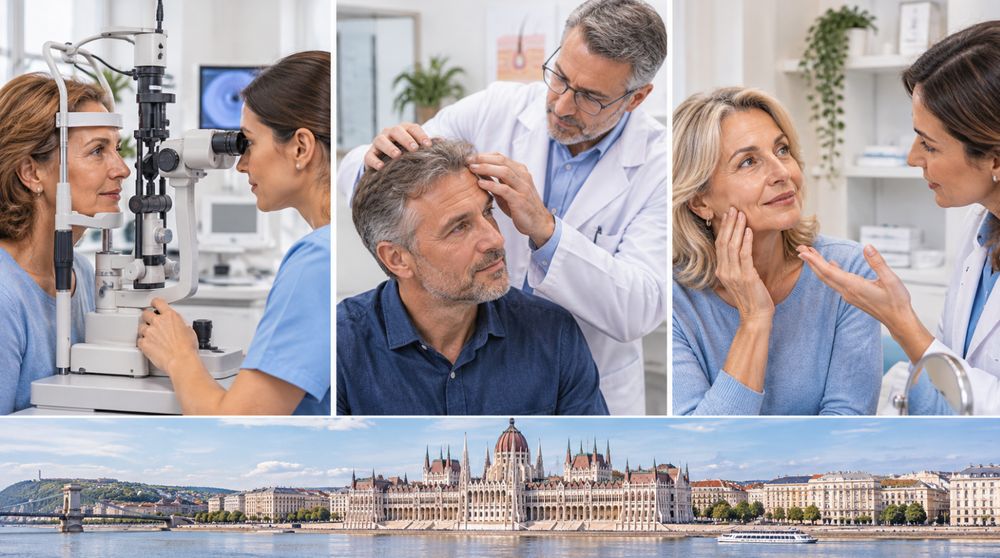
Budapest’s appeal to international patients extends beyond dental implants and crowns. British and American visitors also investigate laser vision correction, hair restoration, and aesthetic medicine, hoping to combine experienced clinical care with manageable private treatment costs.
The attraction is understandable. You may already know the city through a dental visit, feel comfortable with its travel connections, or have received a substantial quotation at home.
However, familiarity with one clinic does not establish the quality of another specialty. An excellent dentist cannot validate an eye surgeon’s outcomes, and a well-organized airport transfer says little about the safety of an injectable treatment.
The right approach is to evaluate each procedure separately: establish suitability, verify the treating professional, compare complete costs, and arrange continuing care.
This guide reviews the main options available to visitors considering Budapest medical tourism. It also distinguishes published provider information from independent evidence. Named clinics are examples for further investigation – not endorsements or facilities that have been independently inspected for this article.
Is Budapest Worth Considering for Medical Tourism?
Budapest can be worth investigating when a suitable procedure, an appropriately qualified clinician, and a workable follow-up plan align.
The potential advantage is not simply a lower fee. A provider may offer convenient scheduling, English-language communication, and an organized diagnostic pathway.
Nevertheless, none of these benefits is guaranteed by location. Assess the individual clinician, facility, and proposed treatment rather than buying into a destination’s reputation.
When Traveling May Make Sense
Medical travel becomes more practical when:
-
The procedure is elective rather than urgent.
-
Your diagnosis and treatment objectives are clear.
-
Savings remain meaningful after travel and recovery costs.
-
You can stay for the required postoperative checks.
-
Suitable follow-up is available after returning home.
-
You can afford an unexpected extension or return visit.
For a small treatment requiring frequent maintenance, local care may offer better overall value.
For major surgery, the financial comparison must account for greater recovery needs and the consequences of being far from the operating team.
Laser Eye Surgery in Budapest: Start With Suitability
LASIK reshapes the cornea to reduce dependence on glasses or contact lenses. It can be life-changing for an appropriately selected patient, but it is elective surgery on otherwise functioning eyes.
The key question is not which clinic offers the newest laser. It is whether the proposed procedure suits your eyes, prescription, lifestyle, and tolerance for risk.
LASIK, PRK, and Other Options Are Not Interchangeable
LASIK involves creating a corneal flap and reshaping the tissue beneath it.
PRK is a surface-based laser procedure with a different healing experience. Other approaches, including small-incision lenticule extraction, use different methods and may suit different patients.
Do not select a technique from a package name. Ask the surgeon why it is preferable to alternatives – including continuing with glasses or contact lenses.
A clinic offering several procedures should still explain why one is appropriate for you, rather than assuming the most expensive technology is automatically best.
What a Proper Assessment Should Establish
A suitability examination should address:
-
Whether your prescription is sufficiently stable.
-
Corneal shape and thickness.
-
Dry-eye symptoms and ocular surface health.
-
Relevant eye disease and previous surgery.
-
Medical conditions or medications affecting healing.
-
Your expectations for distance and near vision.
Contact lenses can temporarily affect corneal measurements. Follow the clinic’s instructions about stopping them before assessment; the required interval depends on lens type and your eyes.
Do not compress preparation simply to preserve flight dates.
Important Considerations After Age 40
Laser distance correction does not automatically remove the need for reading glasses.
Age-related loss of near focusing, called presbyopia, requires a separate discussion. Cataracts or other eye conditions may also change the appropriate recommendation.
If monovision is proposed – one eye targeted more for distance and the other for near tasks – ask about its practical compromises and whether a trial is appropriate.
Promises of permanent freedom from all glasses deserve scrutiny.
Understand the Risks Before Comparing Prices
Possible problems include dry eyes, glare, halos, reduced visual quality at night, and undercorrection or overcorrection.
Some patients still need glasses. Serious complications, including loss of vision, can occur even after careful screening.
A responsible consultation explains both likely recovery and less common but consequential risks. Good outcomes on an eye chart do not necessarily describe night-driving comfort or low-light vision.
A Budapest Provider Example
Sasszemklinika publishes English-language information about laser procedures and suitability examinations.
Its treatment page lists PRK at HUF 199,000 per eye and a femtosecond treatment at HUF 319,000 per eye, alongside other options and promotional prices.
These are provider-published figures, not a personalized quote. Confirm current fees, examination costs, eligibility restrictions, and follow-up arrangements before converting the total into pounds or dollars.
Most importantly, compare both eyes with both eyes. A per-eye advertisement can make the apparent total misleading.
Planning Recovery After Eye Surgery
A short operation does not mean a completed recovery.
The FDA notes that vision may take several months to stabilize after LASIK. Early symptoms and follow-up requirements can therefore extend beyond your Budapest stay.
Establish the Review Schedule Before Booking
Ask the operating clinic:
-
When is the first postoperative examination?
-
Which later checks must occur in Budapest?
-
Can a clinician at home provide agreed follow-up?
-
Who handles an urgent problem outside normal hours?
-
What findings would delay your return journey?
Arrange transport after the procedure and for early appointments. Do not assume you will be able to drive.
Budapest Sightseeing Must Follow the Recovery Plan
Swimming, hot tubs, eye makeup, and certain activities may be restricted.
That matters in a city known for thermal baths. A treatment visit should not include bathing simply because it appears in a tourism package.
Follow the operating surgeon’s instructions, and seek prompt assessment for worsening pain, declining vision, or other concerning changes. An online message is not a substitute for an examination when vision is at risk.
Hair Transplants in Budapest: Assess the Long-Term Plan
Hair transplantation relocates your existing follicles; it does not create an unlimited supply of new hair.
That distinction should shape the entire consultation. A convincing result depends on diagnosis, donor reserves, graft handling, placement, and planning for future hair loss.
Establish Why Your Hair Is Thinning
Not every form of hair loss is suitable for transplantation.
A clinician should assess the pattern, history, scalp condition, and likely progression before recommending surgery. Sudden or unexplained loss deserves medical evaluation rather than an immediate package quotation.
Ask whether medication, monitoring, or another approach should be considered first.
FUE and FUT: Different Trade-Offs
Follicular unit extraction, or FUE, removes follicular units individually from the donor area.
Follicular unit transplantation, or FUT, removes a strip of donor scalp that is divided into grafts.
Both involve surgery and potential scarring. “Scarless” is therefore a misleading description.
Terms such as DHI may describe aspects of implantation rather than an entirely separate source of donor hair. Ask what the named technique actually changes and why that matters in your case.
Hairs Are Not the Same as Grafts
A follicular-unit graft can contain more than one hair.
Consequently, an offer for 5,000 hairs should not be compared directly with another clinic’s quotation for 5,000 grafts.
Request:
-
Estimated graft count.
-
Estimated hair count, if used.
-
Donor area assessment.
-
Planned recipient areas.
-
Expected coverage and density limitations.
-
A strategy for future progression.
The largest number is not automatically the safest or most appropriate plan.
A Budapest Price Example
HairPalace publishes a Budapest package example of £2,490 for 5,000 hairs.
That figure illustrates why units matter: the advertised quantity is hairs, not 5,000 individual grafts.
Before treating it as a complete budget, confirm the current offer, medical inclusions, accommodation arrangements, medications, postoperative care, and exclusions.
American visitors should request the billing currency and understand conversion charges rather than relying on an undated dollar equivalent.
Know Who Performs Each Surgical Step
Ask who designs the hairline, administers anesthesia, removes follicles, creates recipient sites, and places grafts.
Establish the supervising physician’s qualifications and responsibilities. A consultation with a salesperson does not answer questions about surgical staffing.
Avoid selecting a clinic solely because it promises the maximum graft count or uses photographs without comparable lighting and follow-up intervals.
Hair Transplant Recovery Requires Patience
A hair transplant is not a finished cosmetic result when you leave the clinic.
The NHS explains that transplanted hair often sheds after several weeks, with new growth usually appearing around four months. Full results may take 10–18 months.
This timeline is important when interpreting early photographs or planning treatment before a major event.
Discuss Risks and Realistic Coverage
Potential problems include infection, bleeding, scarring, graft failure, and an unsatisfactory appearance.
Existing hair may continue thinning. A natural-looking hairline should therefore be planned around future change, not just immediate density.
Ask how the clinic evaluates progress and when it would consider a revision. A guarantee cannot replace an honest explanation of biological uncertainty.
Aesthetic Clinics: Separate Injectables, Skin Treatments, and Surgery
“Aesthetic treatment” covers very different procedures.
An injectable appointment, laser skin treatment, eyelid operation, and facelift should not share one generic safety checklist or recovery timetable.
Choose the practitioner and setting for the actual intervention.
Injectable Treatments
Botulinum toxin and dermal fillers serve different purposes. Neither should be treated as an incidental add-on to a holiday.
For fillers, request the product name, treatment indication, expected duration, and potential complications. Confirm how the practitioner manages an emergency.
The FDA identifies accidental injection into a blood vessel as a serious filler risk. Consequences can include tissue damage, vision loss, and stroke.
Unusual pain, skin discoloration, or visual symptoms during or after treatment require immediate medical attention.
Skin Lasers and Energy-Based Treatments
Ask what diagnosis is being treated, which device is proposed, and why it suits your skin.
Laser procedures can cause burns, pigment changes, infection, and scarring. Sun exposure and postoperative skin care may affect the treatment plan.
A discounted course requiring repeated visits may be impractical for someone living in another country.
Cosmetic Surgery
Eyelid surgery, facelifts, and body procedures require more extensive assessment than nonsurgical appointments.
Check the surgeon’s relevant specialty training, the facility’s authorization, anesthesia arrangements, and access to emergency care.
Request an individualized recovery and travel plan. Do not accept a universal “safe to fly” interval applied to every operation.
The NHS advises weighing potential overseas savings against risks and carefully investigating qualifications and aftercare.
Can You Combine Dental and Other Medical Treatments?
Sometimes separate consultations can be coordinated during one visit. That does not establish that several procedures should be performed together.
Each treating clinician needs to know about the other proposed treatments and medications.
Why Bundling Can Create Problems
Combining interventions may complicate:
-
Recovery instructions.
-
Medication management.
-
Positioning during treatment.
-
Identification of the cause of a symptom.
-
Scheduling of essential reviews.
-
Fitness for the return journey.
A dental coordinator should not approve an eye procedure’s timing, and an aesthetic practitioner should not determine readiness for oral surgery.
Choose a primary treatment objective. Add other care only when the relevant clinicians agree that the sequence is appropriate.
Compare the Total Cost, Not the Headline Fee
There is no reliable universal saving percentage across Budapest eye surgery, hair transplantation, and aesthetic medicine.
Procedure definitions, patient needs, materials, staffing, and follow-up differ too much for one claim to describe every case.
| Procedure | Pricing detail to establish | Costs commonly requiring clarification |
|---|---|---|
| Laser vision correction | Per eye or both eyes; exact technique | Screening, medication, reviews, enhancement assessment |
| Hair transplantation | Grafts versus hairs; planned coverage | Tests, medication, accommodation, revision terms |
| Injectables | Product, amount, and treatment area | Review, correction assessment, emergency management |
| Skin laser treatment | Device, area, and number of sessions | Preparation, aftercare products, repeat visits |
| Cosmetic surgery | Exact procedure and facility arrangements | Anesthesia, overnight care, garments, follow-up |
Build a Complete Travel Budget
Include flights, lodging, transfers, meals, time off work, and a companion where appropriate.
Also allow for an extended stay or return visit. A price difference that looks substantial before travel may become modest afterward.
Ask for the quotation’s currency, validity period, deposit conditions, and cancellation terms.
Insurance and Follow-Up for British and American Visitors
Do not assume ordinary travel insurance covers planned treatment or its complications.
Disclose the purpose of your trip and obtain written confirmation of the relevant benefits and exclusions.
British Patients
A GHIC or EHIC does not cover traveling abroad for planned medical treatment.
Do not assume the NHS or your GP will provide routine postoperative services requested by an overseas private clinic. Agree on appropriate follow-up before departure.
American Patients
Check your medical insurer’s overseas rules and exclusions for elective or cosmetic treatment.
A benefit for unrelated emergencies does not necessarily cover a complication arising from planned surgery.
For both audiences, establish who pays for an unexpected consultation, hospital admission, revision, or medical evacuation.
A Practical Vetting Checklist
Before paying a deposit, obtain:
-
The treating clinician’s full name and relevant credentials.
-
A documented diagnosis and alternatives.
-
A procedure-specific written quotation.
-
Clear consent information in English.
-
The follow-up schedule and emergency contact route.
-
A plan for care after returning home.
-
Written complication and revision policies.
-
Treatment records and product or device details where relevant.
Also ask who receives payment and whether an intermediary earns a referral fee. Commercial coordination can be useful, but its role should be transparent.
The Bottom Line
Budapest offers options beyond dentistry, including laser eye surgery, hair restoration, and aesthetic treatment. The opportunity deserves investigation – not automatic endorsement.
The strongest decision begins with suitability, not savings. It continues with verified professional responsibility, realistic recovery planning, and follow-up that remains workable after the flight home.
Use published clinic information to build a shortlist, then request a procedure-specific consultation and compare it with advice from home.
A worthwhile medical tourism trip should leave you with more than an attractive quotation. It should give you a clear understanding of the treatment, its limitations, and who will help if recovery does not follow the plan.
FAQs
What medical treatments can international visitors consider in Budapest beyond dentistry?
Options include laser vision correction, hair transplantation, injectable treatments, skin laser procedures, and cosmetic surgery. Each requires its own suitability assessment and safety checks. A clinic’s reputation in one specialty does not establish expertise in another.
How do I know whether I am suitable for LASIK in Budapest?
An eye surgeon must assess your prescription stability, corneal shape and thickness, dry-eye symptoms, and overall eye health. A remote consultation can help with preliminary planning, but it cannot replace the necessary examinations. Ask why the recommended procedure suits you better than alternatives, including continuing with glasses or contact lenses.
How should I compare hair transplant packages?
Check whether the advertised quantity refers to hairs or grafts, because these are not equivalent. Ask about donor reserves, realistic coverage, future hair loss, and who performs each surgical step. Compare complete treatment and follow-up arrangements rather than choosing the largest advertised number.
Are aesthetic treatments in Budapest risk-free if they are nonsurgical?
No. Injectables and skin treatments can cause complications even without an operation. Ask about the practitioner’s qualifications, the exact product or device, and emergency arrangements. Dermal fillers carry rare but serious risks, including tissue damage and vision loss.
Can I combine dental treatment with eye surgery, a hair transplant, or aesthetic procedures?
Possibly, but convenience alone is not a clinical reason to combine treatments. Each treating clinician should know about the other procedures and agree on the sequence, medication management, and recovery requirements. Avoid booking multiple procedures before those discussions take place.
Will insurance cover planned medical treatment in Budapest?
Do not assume so. Ordinary travel insurance may exclude elective treatment and related complications, while a GHIC or EHIC does not cover traveling specifically for planned care. British and American visitors should obtain written confirmation from their insurer about treatment, complications, cancellation, and emergency assistance.
What should I arrange before returning home?
Complete the required pre-departure checks and obtain treatment records, aftercare instructions, medication details, and emergency contact information. Confirm who will provide follow-up at home, which problems require an in-person examination, and who pays if another Budapest visit becomes necessary. A warranty does not automatically cover corrective care, flights, or accommodation.a
Sources
Clinical guidance, patient safety considerations, and the provider-published examples used in this guide are listed below. Clinic pages describe their own services and prices; they do not independently establish treatment quality or outcomes.
- US Food and Drug Administration: LASIK overview
- US Food and Drug Administration: LASIK surgery checklist
- US Food and Drug Administration: Before, during, and after LASIK
- US Food and Drug Administration: LASIK risks and choosing a surgeon
- Sasszemklinika Budapest: Provider-published treatment information and prices
- HairPalace Budapest: Provider-published package and hair-count information
- NHS: Hair transplantation, risks, and recovery
- US Food and Drug Administration: Dermal filler risks and safety
- US Food and Drug Administration: Medical laser procedures and risks
- NHS: Cosmetic surgery abroad
- NHS: Planning medical treatment abroad and healthcare coverage