Key Takeaways
Budapest’s thermal baths offer different experiences, so choose by atmosphere, facilities, and budget – not simply the hottest water.
- Baths: Choose Széchenyi for the classic outdoor setting, Rudas for Ottoman architecture and Danube views, Lukács for swimming and repeat visits, Dandár for a smaller, lower-cost session, or Veli Bej for an intimate historic interior.
- Closures: Gellért is closed for renovation, with reopening planned for 2028. Király remains closed indefinitely.
- Etiquette: Shower before bathing, wear proper swimwear, bring waterproof slippers, and respect quiet areas. Swimming caps are required in designated swimming pools, not every thermal pool.
- Packing: Bring towels, swimwear, slippers, water, and a swimming cap if you intend to swim. Do not assume equipment rental is available.
- Access: Check age restrictions and ticket inclusions. Rudas’s Turkish bath has single-sex and mixed sessions, while Széchenyi, Rudas, and Lukács generally do not admit children under 14.
- Safety: Follow posted bathing guidance, take breaks, and leave the water if you feel unwell. Seek medical advice before hot bathing if pregnancy or a health condition makes heat exposure a concern.
- Planning: Check the operator’s current notices before booking. Prices, holiday schedules, and individual facilities can change.
Allow a few unhurried hours at one bath rather than rushing through several.
Budapest Thermal Baths for Visitors and Expats: Prices, Rules and Local Tips
Budapest’s thermal baths are more than sightseeing stops. They are places to swim before work, meet a friend, enjoy historic architecture, or spend a quiet afternoon away from the city’s traffic.
For a first visit, choose Széchenyi for the grand outdoor setting, Rudas for Ottoman architecture and Danube views, or Lukács for a bath that can fit naturally into everyday Budapest life. For something smaller, consider Dandár or Veli Bej.
The best experience depends less on finding the hottest or supposedly strongest water than on matching the bath to your interests, budget, and comfort.
The guiding principle is pace. Allow time to understand the building, alternate bathing with rest, and resist the temptation to turn every pool into another attraction to complete.
This guide covers bath selection, etiquette, practical planning, and quieter alternatives for holidaymakers and prospective expats. Information reflects October 2026; check the operator’s current notices before travelling.
First, Know Which Budapest Baths Are Open
Older Budapest travel guides can send you to a closed entrance.
Gellért Thermal Bath closed on 1 October 2025 for renovation. Its official website gives a planned reopening in 2028. Treat that as a project timetable, not a guaranteed booking date.
Király Thermal Bath is also closed indefinitely according to its official website.
Neither should appear in your current itinerary as an operating bath.
Széchenyi, Rudas, Lukács, Dandár, and Veli Bej provide alternatives, although individual pools, saunas, or services can close temporarily.
Before buying admission, check:
-
Whether the facilities you want are operating.
-
Whether your ticket includes those facilities.
-
The age restrictions.
-
Any timed-entry conditions.
-
The bathing schedule, particularly at Rudas.
-
Holiday opening hours and prices.
The complex’s closing time may not be your final swimming time. Operators can require guests to leave pools before the building closes.
Understanding Budapest’s Thermal Water
Thermal water is naturally warm water drawn from underground. Mineral composition varies between sources, so Budapest’s baths do not all provide identical water.
Széchenyi’s official description identifies calcium, magnesium, bicarbonate, sodium, and sulphate, alongside other constituents.
However, a mineral list is not a reliable ranking of which bath is “best.”
Thermal, Medicinal, and Swimming Pools Are Different
A bath complex may contain warm medicinal-water pools, cooler swimming pools, leisure pools, and plunge pools.
These serve different purposes. A lane pool is designed for exercise. A warm sitting pool is not the place for swimming lengths or splashing.
Read the signs beside each pool. They identify temperature and may specify bathing limits or other restrictions.
Do Thermal Baths Provide Medical Treatment?
Hungary has an established medical bathing tradition, and some bath operators provide physician-led services.
That does not make an ordinary tourist admission a personalised treatment programme. Nor does it mean every claimed benefit applies to every visitor.
Choose a recreational visit for the setting, relaxation, and experience. If you want treatment for a medical condition, consult a qualified clinician and ask about the appropriate service.
Do not drink pool water. A designated drinking fountain is a separate facility with its own instructions.
Which Budapest Thermal Bath Should You Choose?
| Bath | Best suited to | Main consideration |
|---|---|---|
| Széchenyi | A memorable first visit and outdoor bathing | Higher admission cost and a busy atmosphere |
| Rudas | Ottoman architecture and rooftop views | Different access rules across sections and sessions |
| Lukács | Swimming, repeat visits, and local routines | A less immediately intuitive layout |
| Dandár | A smaller, lower-cost bathing session | Fewer grand architectural spaces |
| Veli Bej | An intimate historic interior | Session arrangements and limited capacity |
There is no need to visit every bath. One carefully chosen session is more enjoyable than several hurried ones.
For a longer stay, try two contrasting places: a major landmark bath and a smaller neighbourhood alternative.
Széchenyi: The Classic First-Time Experience
Széchenyi stands in City Park, on the Pest side of Budapest, at Állatkerti körút 9–11.
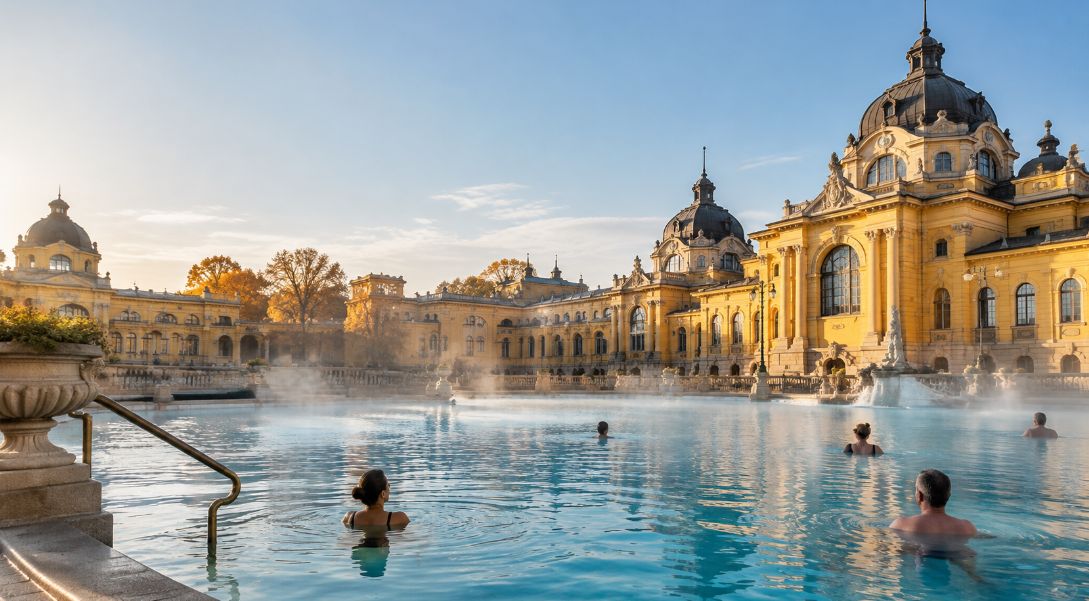
Its yellow architecture and expansive outdoor bathing areas make it the clearest choice if you want the recognisable Budapest bath experience.
The outdoor setting is particularly appealing in cooler weather, when warm water contrasts with the air. Bring suitable footwear and a towel for the transitions between water and buildings.
What Makes It Worth Visiting?
Széchenyi combines architectural spectacle with a choice of bathing and swimming environments.
It works well for couples or friends with different interests: one person may prefer soaking while another wants to swim.
However, its popularity means it is not an undiscovered retreat. If you want conversation-free tranquillity, choose a smaller bath or adjust your expectations.
Practical Planning
The official FAQ recommends advance booking. It also distinguishes standard admission from fast-track products, which can have specific entry windows.
Bring your own towel, swimsuit, slippers, and swimming cap if you plan to use the lap pool. Standard admission does not include these items, and rental is not available.
Metro line M1 provides access to the area. Pair bathing with a gentle City Park walk rather than another demanding activity.
Rudas: Ottoman Atmosphere and Danube Views
Rudas stands at Döbrentei tér 9, on the Buda side near Elisabeth Bridge.
Its appeal lies in the contrast between the historic Turkish bath and newer wellness facilities, including the rooftop pool.
Choose it when the building itself matters as much as the bathing.
Check the Turkish Bath Schedule Carefully
The Turkish bath is not mixed throughout every weekday.
The current schedule includes women-only sessions, men-only sessions, and mixed periods. Tuesday is identified as women-only for the Turkish bath, while Wednesday is men-only.
Other weekdays include shorter single-sex periods followed by mixed bathing.
These arrangements do not mean every section of the complex follows the same access schedule. Read the detailed timetable, not simply the headline opening hours.
Couples should confirm a suitable mixed session before buying.
Buy the Facilities You Actually Want
Rudas sells different admission products. Check whether yours covers the Turkish bath, wellness area, rooftop pool, or other facilities.
Night bathing is a separate planning decision. It can be atmospheric, but it is not automatically equivalent to a daytime visit with every service available.
For an unhurried itinerary, combine Rudas with a Danube-side walk and a meal nearby.
Lukács: A Strong Choice for Longer Stays
Lukács is on the Buda side near Margaret Bridge.
It deserves attention from prospective expats because it offers more than a one-off landmark experience. Its combination of swimming, thermal bathing, and wellness facilities can support a repeat routine.
The building may require more orientation than a straightforward hotel spa. Ask staff where to find the thermal pools, swimming areas, and changing facilities.
Why Choose Lukács?
Choose it if you want to explore how bathing could fit into ordinary life in Budapest.
For swimmers, the dedicated swimming pools matter. For occasional visitors, the combination of different facilities provides variety without requiring a second venue.
A first visit should be exploratory. Learn the layout and check which facilities are operating before deciding whether it suits a regular habit.
Resident Discounts and Tourist Passes
The official price page lists different ticket categories and recognises Budapest Card arrangements.
However, do not assume every city pass, student card, or foreign pension document qualifies for a concession.
Check the accepted product, required evidence, and included admission. A discount is valuable only if the underlying ticket suits your plans.
Dandár: A Smaller Neighbourhood Alternative
Dandár Thermal Bath stands at Dandár utca 5–7 in District IX, Ferencváros.
It is a practical recommendation for people who want warm-water bathing without paying primarily for monumental surroundings.
The atmosphere is smaller-scale than Széchenyi. That makes it useful for a shorter session or a regular routine, rather than an elaborate sightseeing day.
Why It Qualifies as a Local Gem
Dandár’s appeal is its straightforwardness: a manageable complex, accessible pricing, and a location outside the main landmark-bath circuit.
However, “local” does not mean empty, and a smaller venue can feel busy quickly.
Check whether your ticket includes outdoor pools and sauna access. The basic thermal ticket and the broader complex ticket are not identical.
Combine a visit with time in Ferencváros rather than travelling across the city solely to chase the lowest admission price.
Veli Bej: A More Intimate Historic Bath
Veli Bej is at Árpád fejedelem útja 7 in Buda, near Lukács.
Operated by the Hospitaller Order, it offers a historic Turkish-bath environment on a more intimate scale than Budapest’s largest complexes.
Choose it if you value the interior atmosphere over a large outdoor setting.
Plan Around Sessions
Do not assume uninterrupted all-day access. Check the operator’s current timetable, session duration, and ticket arrangements.
For the October 2026 national-holiday weekend, the operator advertised three-hour admission and separate morning and afternoon opening periods.
That illustrates why old blog schedules are not sufficient for planning.
Veli Bej is better approached as a destination for a deliberate, quiet session than an attraction squeezed between several other bookings. Leave flexibility if admission capacity is reached.
Thermal Bath Etiquette: What Visitors Need to Know
Budapest bath etiquette is mostly about hygiene, shared space, and following the rules of the particular facility.
Shower Before Entering
Use the showers before your first pool and follow instructions when moving between facilities.
A thermal pool is shared bathing water, not a place to wash off a day’s sightseeing.
Wear Purpose-Made Swimwear
For mixed bathing, bring proper swimwear.
Széchenyi’s current official rules allow several styles, including swim shorts and purpose-made full-coverage swimwear. They prohibit ordinary streetwear and non-swimming sportswear.
Do not rely on outdated claims that every bath accepts or rejects the same clothing.
Single-sex historic-bath sessions can have their own arrangements. Ask the operator rather than assuming nudity rules.
Bring Waterproof Slippers
Bath footwear is required at major venues, including Széchenyi and Lukács.
Wear it around the facility, but remove it before entering pools where required. Széchenyi explicitly prohibits slippers and rubberised shoes in its pools.
Choose footwear that is easy to remove and suitable for wet surfaces.
Use a Swimming Cap Where Required
A cap is generally associated with designated swimming pools, not every warm soaking pool.
At Széchenyi, the requirement applies to the lap pool. Signs identify where it is mandatory.
Bring one if you intend to swim; do not assume a towel or another head covering is an acceptable substitute.
Respect the Purpose of Each Space
Keep voices low in quiet thermal areas. Avoid splashing, blocking steps, or occupying a jet indefinitely while others wait.
In swimming lanes, observe the direction of movement and the pace of other swimmers.
If you are unsure, pause and watch before entering.
Keep Phones Out of Private Spaces
Do not photograph changing rooms or other guests without consent.
Photography policies differ, and some spaces restrict electronic devices. At Széchenyi, electronic devices are prohibited in saunas and hot-air chambers without management approval.
A waterproof phone pouch does not override privacy or house rules.
Lockers, Cabins, and What to Pack
A locker ticket provides storage in a changing area. A cabin ticket provides a private changing compartment that may also store your belongings.
A cabin is not a private bath, massage room, or hotel-style treatment suite.
At Széchenyi, cabins provide more storage than lockers, which can be useful for larger bags. Nevertheless, travelling light is simpler.
Pack:
-
Purpose-made swimwear.
-
Waterproof slippers.
-
A drying towel.
-
A separate sauna towel if needed.
-
A swimming cap for lap swimming.
-
Drinking water in an allowed container.
-
A bag for wet clothing.
-
Booking details and any required identification.
Do not assume a robe, towel, or locker is included in every package. Read the product description.
How to Bathe Comfortably and Safely
There is no prize for using the hottest pool or staying longest.
Begin with a comfortable temperature, observe the posted guidance, and take breaks.
Avoid treating an all-day ticket as an instruction to remain immersed all day. Resting outside the water is part of the visit.
If you are pregnant, have cardiovascular or blood-pressure concerns, or another condition affected by heat, obtain medical advice before hot bathing.
Leave the water if you feel dizzy, faint, nauseated, or unwell, and seek staff assistance.
Do not combine prolonged heat exposure with heavy drinking. You also do not need an icy plunge to complete an “authentic” experience.
For prescribed treatments, follow the clinician’s instructions rather than a generic online bathing circuit.
Can Children Visit Budapest’s Thermal Baths?
Do not assume Budapest’s landmark baths are family swimming centres.
Széchenyi has excluded visitors under 14 since 1 August 2025, apart from a narrowly defined specialist-medical exception requiring advance approval. The restriction applies to the complex, including outdoor pools.
Rudas and Lukács also state that under-14s are not admitted.
For younger children, investigate venues designed to accommodate families. Széchenyi’s official FAQ suggests Csillaghegy, Paskál, and Palatinus as alternatives.
Check seasonal operation, individual pool restrictions, and current facilities before choosing. A family-friendly venue does not make every hot medicinal pool suitable for children.
Prices and Booking: Spend on the Experience You Want
Current official prices show substantial differences between venues.
| Example ticket | Published October 2026 price |
|---|---|
| Széchenyi daily admission with locker, Monday–Thursday | HUF 13,200 |
| Széchenyi daily admission with locker, Friday–Sunday | HUF 14,800 |
| Lukács adult admission, Monday–Thursday | HUF 7,000 |
| Lukács adult admission, Friday–Sunday and holidays | HUF 8,000 |
| Dandár adult thermal ticket, weekday | HUF 3,500 |
| Dandár complex ticket, weekday | HUF 4,500 |
These are different products, not like-for-like packages. Holidays, premium services, and optional facilities can change the bill.
Keep your budget in forints rather than relying on a fixed dollar or pound conversion.
At Széchenyi, online purchases have restrictive change and refund conditions. Confirm your date before paying.
Book through the operator or a clearly identified seller. Compare inclusions before assuming a more expensive reseller package provides better access.
Turning Bathing Into Local Life
For prospective expats, repeat visits reveal more than a single sightseeing session.
Try the same bath at different times. Assess travel time, changing facilities, swimming access, and how refreshed you feel afterwards.
Ask about multi-entry products and resident offers, but confirm eligibility before purchasing. Széchenyi’s resident and student arrangements have specific conditions; a foreign passport or university card alone does not establish entitlement.
A sustainable routine might be a shorter weekday visit to Dandár, swimming and soaking at Lukács, or an occasional architectural treat at Rudas.
The most useful “hidden gem” is often not an unknown building. It is the combination of a suitable venue, a convenient journey, and a time when you can enjoy it properly.
Plan Your First Visit
For a first holiday visit, allow a few unhurried hours at one bath and keep the rest of the day flexible.
Choose Széchenyi for the classic outdoor setting, Rudas for historic atmosphere and views, Lukács for variety, Dandár for a smaller practical session, or Veli Bej for an intimate interior.
Check current notices, pack your own essentials, and read the pool signs.
Budapest’s bathing culture becomes easier to appreciate when you stop treating it as a checklist. The architecture brings you through the door; the slower rhythm gives you a reason to return.
Frequently Asked Questions
Which Budapest thermal bath is best for a first visit?
Széchenyi is a strong choice for first-time visitors who want grand architecture and outdoor thermal pools. Choose Rudas for Ottoman interiors and Danube views, or Lukács for a combination of swimming and thermal bathing. Dandár and Veli Bej offer smaller-scale alternatives.
What should I bring to Budapest’s thermal baths?
Bring proper swimwear, waterproof slippers, a towel, and a bag for wet clothing. Pack a swimming cap if you intend to use a designated swimming pool. Check your ticket’s inclusions before visiting, as towels, robes, and equipment rental are not automatically available.
Are Budapest’s thermal baths suitable for children?
Not all thermal baths admit children. Széchenyi, Rudas, and Lukács generally exclude visitors under 14. Families with younger children should investigate alternatives such as Palatinus, Paskál, or Csillaghegy, checking seasonal opening and individual pool restrictions before travelling.
Are Budapest’s thermal baths mixed, or do men and women bathe separately?
Many Budapest baths offer mixed bathing, but Rudas’s Turkish bath has both single-sex and mixed sessions. Its different sections do not necessarily follow the same schedule. Couples and groups should check the official timetable and confirm that their ticket includes the facilities they want.
Are Gellért and Király Baths open?
As of October 2026, neither is open. Gellért closed for renovation on 1 October 2025, with reopening planned for 2028. Király remains closed indefinitely. Check the operators’ official notices before planning a future visit, as reopening schedules can change.
Sources
Official Visitor Rules and Water Information
- Széchenyi Thermal Bath — Official FAQ, Clothing Rules, Age Restrictions, Booking, and Changing Facilities
- Széchenyi Thermal Bath — Thermal Water Composition
- Széchenyi Thermal Bath — General Information and Medical Services
- Széchenyi Baths Booking and Visitor Guide — Thermal Bathing Safety Information
Opening Schedules and Closures
- Rudas Thermal Bath — Official Opening Hours and Single-Sex and Mixed Sessions
- Gellért Thermal Bath — Official Closure and Planned Reopening Notice
- Király Thermal Bath — Official Indefinite Closure Notice
- Veli Bej Bath — Operator Notices, Address, and Holiday Session Information
Prices and Smaller Baths