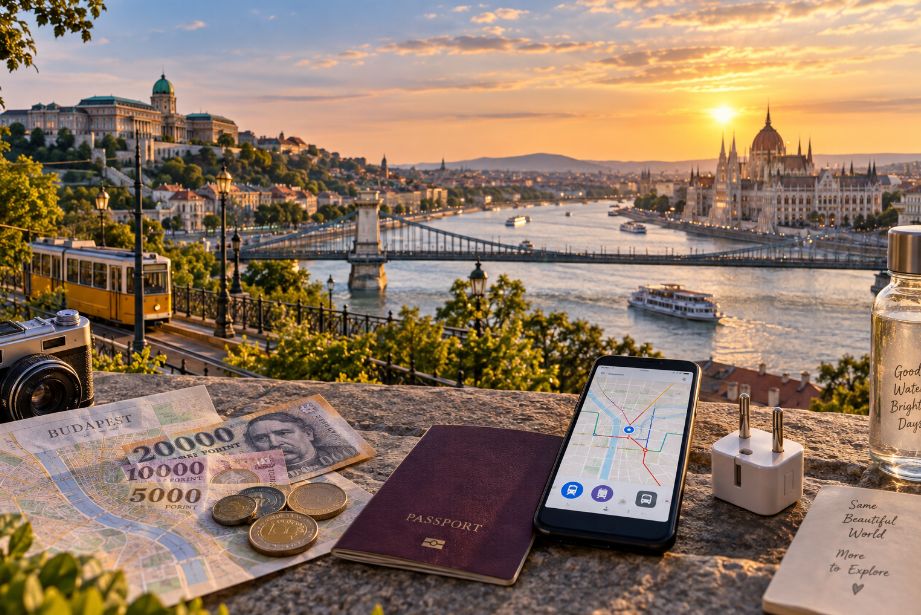
Budapest Travel Tips
- Visa-free visits: US and UK citizens can generally visit Hungary and the wider Schengen Area visa-free for up to 90 days in any rolling 180-day period. Time spent in other Schengen countries counts toward the same limit.
- Passport validity: Your passport should remain valid for at least three months after your planned departure from the Schengen Area. UK travellers should also ensure their passport was issued less than 10 years before arrival.
- Carry your original passport: Hungarian police may ask for identification, and a photocopy alone may not be accepted. Keep the original passport secure and store digital copies separately.
- Use Hungarian forint: Hungary uses HUF/Ft, not the euro. Pay in forint whenever possible and decline any card-terminal conversion to pounds or US dollars.
- Avoid bad exchange rates: Do not exchange money with street vendors or rely on airport exchange kiosks. Use an ATM operated by a recognised bank, ideally inside a bank branch, and check for unexpected fees.
- Cards work almost everywhere: Visa and Mastercard are widely accepted across Budapest. Bring a backup card and carry a small amount of forint cash for markets, small businesses or public toilets.
- Download BudapestGO: BKK’s official app helps you plan routes, check live transport information and purchase eligible tickets, travelcards and the 100E Airport Express ticket.
- Validate public-transport tickets: Paper tickets must be validated correctly, while digital tickets need app-based activation or QR/NFC validation where required. An unvalidated ticket can lead to a fine.
- Use the 100E from the airport: The official 100E Airport Express connects Budapest Airport with Deák Ferenc tér in the city centre. It needs a special Airport Express ticket—ordinary single tickets do not apply.
- Choose official taxis: Book through reputable providers such as Főtaxi or City Taxi, or use apps such as Bolt. Avoid unsolicited airport, station or nightlife taxi offers.
- Watch for bar scams: Be cautious if strangers or taxi drivers recommend a particular bar, club or “special local place.” Check prices before ordering and never agree to withdraw cash under pressure.
- Protect valuables: Budapest is generally safe, but pickpocketing can happen on busy trams, metros, markets, train stations and tourist streets. Keep phones, wallets and passports in a closed, secure bag.
- Tap water is generally safe: Budapest tap water is usually safe to drink. In older buildings, let cold water run briefly if it has been standing in the pipes.
- Tipping is customary: A 10% tip is common in restaurants and bars when a service charge is not already included. Check the bill for szervizdíj before adding more.
- Bring a plug adapter: Hungary uses Type C and F sockets with 230V/50Hz electricity. US visitors need an adapter and should confirm devices support 100–240V; UK visitors normally only need a continental-Europe adapter.
- Call 112 in an emergency: Hungary’s nationwide emergency number is 112, with English-speaking assistance available for emergency calls.
Budapest Entry Requirements, Money, Transport and Safety: A Visitor Guide
Budapest is an easy city to fall in love with, but it rewards travellers who understand a few local basics before arriving. For visitors from the United Kingdom and United States, the essentials are straightforward: respect the Schengen 90/180-day rule, bring a passport with sufficient validity, pay in Hungarian forint, use official transport and taxis, and stay alert in crowded tourist areas.
This practical Budapest travel guide covers entry requirements, money, airport transfers, public transport, mobile connectivity, safety, tipping, drinking water and everyday etiquette—so you can spend less time solving avoidable problems and more time enjoying the Danube, thermal baths, cafés, markets and historic streets.
Important: Entry, transport fares, security guidance and financial rules can change. Check the latest official government and transport authority information shortly before departure, particularly if you are travelling with children, using medication, driving or planning to stay for an extended period.
Entry Requirements
Do UK and US citizens need a visa for Budapest?
For a normal city break, US and UK citizens can generally travel to Hungary without a visa for up to 90 days in any rolling 180-day period. Hungary is in the Schengen Area, so this allowance applies across the Schengen zone—not separately to each country you visit. Time spent in Hungary, Austria, France, Italy, Spain or other Schengen states counts toward the same 90-day total.
This visa-free allowance covers tourism, visiting friends or family, and certain short business visits. It does not automatically grant permission to take a Hungarian job, move to Budapest, study long-term or remain beyond the permitted period.
For UK travellers, the passport must also have been issued less than 10 years before the date of arrival in the Schengen Area. This detail matters for some British passports issued before October 2018, where extra validity months were added on renewal.
If you overstay the Schengen limit, you may face fines, removal measures or a future entry ban. GOV.UK notes that overstaying the 90-day visa-free limit may result in a ban from entering Schengen countries for up to three years.
Passport validity rules
Your passport should be valid for at least three months beyond the date you intend to leave the Schengen Area. The US State Department states that American visitors must meet this three-month passport-validity rule for Hungary, while UK government guidance confirms the same condition for British passport holders.
For peace of mind, travel with more than the minimum validity where possible. Airlines can refuse boarding if a passport does not meet destination requirements, even when you believe your travel dates are within the limit.
Before flying to Budapest, check:
- Your passport has at least three months’ validity beyond your planned Schengen departure.
- Your passport is in good condition and has space for border stamps, if required.
- UK passports were issued within the previous 10 years at the date of arrival.
- You can show proof of onward or return travel if asked.
- You have accommodation details available on your phone and in a saved offline format.
- You can demonstrate that you have sufficient funds for your stay if requested at the border.
US citizens may have a specific bilateral option for an additional 90 days in Hungary in limited circumstances, but it does not allow onward Schengen travel and requires careful planning. It is not a substitute for checking current official rules before travel.
Carry your passport, not only a copy
Hungarian police can require visitors to identify themselves. Both the US State Department and the UK Foreign, Commonwealth & Development Office advise carrying your passport; a photocopy is not considered sufficient if police ask for identification.
This does not mean you should display your passport unnecessarily. Keep it secure in a zipped inner pocket, money belt or hotel safe when appropriate, but make sure you can access the original document. A practical compromise is to carry it in a secure concealed pouch while keeping scanned copies, insurance details and emergency contacts stored separately.
Money and Payments
Hungary uses the forint, not the euro
Hungary is a member of the European Union, but it does not use the euro as its official currency. The local currency is the Hungarian forint, shown as HUF or Ft.
Prices in Budapest are normally displayed in forint. Some tourist businesses may quote prices in euros, but paying in forint is usually clearer and often better value. If a card terminal offers to charge you in pounds or US dollars, choose HUF rather than accepting the conversion offered by the terminal. This is commonly known as dynamic currency conversion, and the exchange rate is often less favourable than your bank or card provider’s rate.
The US State Department notes that Visa and Mastercard are widely accepted in Hungary, including for in-store purchases and cash withdrawals. Major electronic wallets such as Apple Pay and Google Pay are also accepted in many places. American Express is accepted less consistently, so it is wise not to rely on it as your only payment method.
For a typical Budapest trip, bring:
- One main Visa or Mastercard.
- One backup card stored separately.
- A modest amount of Hungarian forint for small purchases, markets, public toilets or businesses that prefer cash.
- A card with low or no foreign-transaction fees if possible.
- A way to access your banking app and freeze a card quickly if it is lost.
Use official ATMs and banks
Avoid exchanging cash at airport kiosks, unofficial exchange desks with unclear terms or anywhere on the street. The UK government specifically advises using official ATMs or banks and warns against changing money on the street. It also recommends using ATMs inside banks where possible and inspecting street machines for signs of tampering.
The most sensible approach is usually:
- Withdraw a small amount of forint from an ATM operated by a recognised bank.
- Decline dynamic currency conversion and select the charge in HUF.
- Keep your card in sight while paying.
- Check the amount shown on the terminal before tapping, inserting or approving payment.
- Avoid carrying your entire travel budget in cash.
Budapest is largely card-friendly, but cash remains useful. Smaller market stalls, rural businesses, older cafés and certain service providers may prefer or require forint cash. The US State Department notes that some smaller towns and establishments accept cash only.
Check menus and bills before paying
Tourist-targeted overcharging does happen. UK travel guidance warns that some bars, clubs and restaurants may charge very high amounts for food and drinks and that tourists have been pressured to withdraw cash to settle bills. Check menus for clear prices before ordering and inspect the final bill carefully.
This is especially relevant in heavily visited nightlife zones. If a stranger approaches you with an invitation to a “great local bar,” or a taxi driver strongly recommends a specific club, take it as a reason to slow down—not as an automatic recommendation.
A legitimate venue should have:
- A visible menu with prices.
- A clear drinks list.
- An itemised bill.
- Normal card-payment procedures.
- Staff willing to explain charges before you order.
If prices are unclear, leave before ordering.
Getting Around Budapest
Download BudapestGO before you arrive
Budapest has an extensive and useful public-transport system: metro lines, trams, buses, trolleybuses, suburban rail services and night routes. The best single planning tool for visitors is the official BudapestGO app from BKK, Budapest’s public transport authority.
BudapestGO provides journey planning with real-time information and allows users to purchase eligible digital tickets, travelcards and the dedicated Airport Express 100E ticket.
Download the app before landing, set up a payment method while you have reliable Wi-Fi and save your hotel or apartment address. You can use it to compare routes, see disruptions, purchase tickets and avoid guesswork at unfamiliar stops.
The app is especially useful for first-time visitors staying outside the central core, such as in District XI, XIII, VIII or parts of Buda. Budapest’s public transport is often faster and less stressful than relying on taxis for every journey.
Ticket validation is not optional
The most common public-transport mistake in Budapest is buying a physical ticket but failing to validate it.
For paper tickets, you generally need to validate the ticket before travel or immediately after boarding, depending on the service. GOV.UK advises that passengers must validate tickets at metro-station entrances and immediately after boarding buses, trams or trolleybuses. You should keep the ticket until the end of the journey because inspectors can request it at any point.
For digital tickets, follow the in-app validation process. BKK explains that digital single tickets require you to scan the validation code before boarding, while NFC validation is available at certain metro entrances and next to doors on trams, buses, trolleybuses and suburban trains.
Do not assume that visibly holding an unused ticket is enough. An unvalidated single ticket may be treated as no valid ticket at all, and fines can be significant. The US State Department also warns that many tickets must be validated and that fines for travelling without a validated ticket can be high.
Remember these rules:
- Validate a physical ticket correctly.
- Activate or scan a digital ticket before boarding where required.
- Keep your ticket or pass available for inspection.
- Use a new single ticket when changing vehicles or modes, unless you hold a valid time-based ticket or travelcard that permits transfers.
- Do not assume that a standard city ticket works on the 100E Airport Express.
Choose the right pass
The best ticket option depends on how you travel.
A single ticket may suit a visitor making only one or two journeys. A 24-hour or 72-hour travelcard can be convenient for a packed sightseeing itinerary. Time-based tickets may suit travellers making multiple transfers over a shorter period.
BudapestGO allows the purchase of single tickets, time-based tickets and 24-hour or 72-hour travelcards. It also explains that time-based tickets allow multiple transfers within their validity period, whereas a single ticket is for one continuous journey without interruptions or return travel.
Before buying, consider your realistic schedule. If you are staying in District V or near the Danube and plan to walk most of the time, a travelcard may not save money. If you are combining Buda Castle, Heroes’ Square, Széchenyi Thermal Bath, Margaret Island and evening dining across the city, a pass can reduce friction.
From Budapest Airport to the City Centre
Take the official 100E Airport Express
For many visitors, the simplest airport-to-centre option is the official 100E Airport Express bus. It runs between Ferenc Liszt International Airport and Deák Ferenc tér, one of Budapest’s main central transport hubs, via Kálvin tér.
Deák Ferenc tér is particularly convenient for central hotels and apartments in Districts V, VI and VII, and it connects with multiple metro lines. From there, many visitors can walk, take a short taxi ride or continue by metro.
The 100E requires a dedicated Airport Express ticket. Standard BKK single tickets and ordinary travelcards are not automatically valid on this service. BKK confirms that travellers can buy the Airport Express ticket through BudapestGO, while tickets are also sold through BKK customer services, ticket offices and machines.
The route is practical, but do not treat it as a private transfer. If you have a large amount of luggage, are arriving with very young children, are staying far from central Pest or land after a difficult overnight flight, a pre-booked official taxi or reputable app-based taxi may be more comfortable.
Use reputable taxis and ride-hailing apps
If you take a taxi, choose a recognised company or book through a trusted app. The US State Department identifies Főtaxi, City Taxi and 6×6, along with app-based options such as Bolt, as more transparent choices. It also notes that Uber operates in Budapest through a partnership with licensed taxi company Főtaxi.
Avoid accepting unsolicited taxi offers at the airport, train stations or outside nightlife venues. Before getting in, check:
- The booking app shows the correct vehicle registration and driver.
- The taxi has visible company branding and a working meter.
- The driver understands the destination or can follow it on your map.
- The estimated fare appears plausible.
- You are not being diverted to a bar, club or exchange office.
Never let a driver pressure you into changing your destination. The UK government warns that some taxi drivers receive commissions for taking tourists to scam venues.
Connectivity, Apps and Electricity
Mobile data and eSIMs
Reliable mobile data makes Budapest significantly easier. It helps with BudapestGO, navigation, translation, ride-hailing, restaurant reservations, banking alerts and emergency communication.
UK travellers should check roaming terms before departure. Since the UK left the EU, “roam like at home” is no longer guaranteed by law, and mobile providers can apply different data allowances, fair-use rules or charges.
US travellers should compare their carrier’s international plan with an eSIM or local SIM option. For a short city break, an eSIM can be convenient because it can be installed before take-off and activated shortly after arrival. For longer stays, a local Hungarian SIM may offer better value.
Download these before your trip:
- BudapestGO for official public transport.
- Google Maps or another offline map service.
- A translation app with Hungarian downloaded offline.
- Your airline, hotel and travel-insurance apps.
- Your bank’s app with card-freeze access enabled.
- A reputable taxi or ride-hailing app.
Plugs and voltage
Hungary uses continental European Type C and Type F plug sockets and operates on approximately 230V / 50Hz electricity.
US visitors will need a plug adapter and should check that their chargers are dual-voltage. Many modern phone, laptop and camera chargers state something similar to “100–240V, 50/60Hz,” meaning they only need an adapter. Appliances designed only for 110–120V, such as some hair tools, may require a voltage converter or may not be suitable for use.
UK visitors usually need a continental-European plug adapter because UK Type G plugs do not fit Hungarian sockets. Most UK chargers are already designed for 230V electricity, so a simple adapter is typically enough.
Pack at least one high-quality adapter rather than relying on a cheap airport purchase. If you travel with multiple devices, consider a compact USB-C charger with interchangeable plugs.
Safety, Scams and Local Awareness
Budapest is generally safe, but petty crime exists
The US State Department currently advises travellers to exercise normal precautions in Hungary and describes the country as generally safe. However, it also warns that crimes against foreigners are often opportunistic, including pickpocketing and purse snatching, especially in tourist areas, busy public transport and major train stations.
The UK government similarly warns that bag-snatching and pickpocketing are common in Budapest, particularly on busy transport, at train stations, in markets and in heavily visited areas.
Treat Budapest as you would London, New York, Paris or any major city:
- Keep phones, wallets and passports secure.
- Avoid putting valuables in back pockets or open handbags.
- Use a cross-body bag with a zipped closure.
- Stay alert on crowded metro trains, trams, buses and escalators.
- Keep luggage in sight at stations and on international trains.
- Do not leave bags in a parked car.
- Use hotel safes selectively, keeping essential documents secure.
The Budapest–Vienna–Bratislava–Prague rail corridor is especially worth noting. US authorities report pickpocketing on international trains serving these routes, so keep passports, cards and electronics on your person rather than in an overhead bag.
Avoid bar and club scams
Budapest has a lively nightlife scene, from rooftop bars and wine bars to ruin pubs and clubs. Most venues are legitimate and enjoyable. The risk arises when visitors are approached by strangers or directed to a particular venue by an insistent taxi driver, promoter or dating-app match.
Red flags include:
- A stranger inviting you to a “special” bar nearby.
- A taxi driver claiming your original destination is closed and proposing another venue.
- No clearly priced menu.
- Pressure to order bottles or premium drinks.
- A bill that arrives without itemisation.
- Staff demanding a cash withdrawal or refusing reasonable questions.
Buy your own drinks, watch them being prepared and do not leave them unattended. Both US and UK travel advice warn of drink-spiking reports in Budapest and recommend refusing food or drinks from strangers.
If you believe you are in danger, call 112, the European emergency number. English-speaking responders are available for emergency calls in Hungary.
Be mindful around demonstrations
Political demonstrations may occur in Budapest, particularly on major national dates such as 15 March and 23 October. They are often peaceful, but official advice is to avoid large crowds, monitor local news and move away if an event becomes tense or disruptive.
This is less about avoiding the city and more about maintaining situational awareness. If you see police cordons, large crowds or public-transit diversions, choose another route and check BudapestGO for service updates.
Tap Water, Dining and Tipping
Can you drink tap water in Budapest?
In general, Budapest tap water is safe to drink. The US State Department says tap water is generally safe for drinking and cooking, although it notes that older plumbing materials can still create local concerns in some buildings.
For most visitors, refilling a reusable bottle is a sensible way to save money and reduce plastic waste. In an older apartment building, if water has been sitting in the pipes for a long time, let the cold tap run briefly before filling your bottle.
At restaurants, be specific if you want tap water. Ask for csapvíz (“tap water”), because servers may otherwise offer still or sparkling bottled water. You can also use English: “Could we have tap water, please?”
Tipping in Budapest
Tipping is customary in Budapest, but the amount and method can vary.
A typical restaurant or bar tip is around 10%, particularly where a service charge has not already been added. Check the bill first for wording such as szervizdíj or “service charge.” If a service charge is included, an additional tip is optional rather than expected.
A practical guide:
When paying by card, ask whether you can add a gratuity before completing the transaction. If paying cash, hand over the amount you want to pay rather than leaving money on the table where practical.
The most important rule is to check the bill. Tipping should reward good service, not duplicate a mandatory service charge.
Small Cultural Tips That Improve Your Trip
Budapest is cosmopolitan and used to international visitors, but small courtesies go a long way.
Start interactions with a greeting. Jó napot kívánok means “good day” and is a polite option in shops, cafés and restaurants. Köszönöm means “thank you,” while kérem means “please.”
Use a quiet indoor voice on public transport, offer seats to older passengers or people who need them, and avoid blocking escalators or tram doors with luggage. Budapest is a working capital city, not only a tourist attraction, and observing everyday manners makes the experience smoother for everyone.
Also remember that Hungary has a zero-tolerance approach to drink-driving. If you plan to drive, do not drink alcohol at all. British government advice states that it is illegal to drink any alcohol and then drive in Hungary.
Final Checklist for Budapest Visitors
Before you leave for Budapest, make sure you have:
- A passport valid for at least three months after your planned Schengen departure.
- Confirmation that your total Schengen stay remains within the 90 days in 180 days allowance.
- Travel insurance that includes medical cover and ideally evacuation protection.
- A Visa or Mastercard plus a separate backup payment method.
- A plan to withdraw HUF from a recognised bank ATM and decline dynamic currency conversion.
- BudapestGO downloaded and set up.
- A dedicated 100E Airport Express ticket plan if using the airport bus.
- A European plug adapter and a check that your devices support 230V.
- Offline maps, hotel address, emergency contacts and key booking confirmations.
- Awareness that original passport identification may be required by police.
- A secure bag and a plan for protecting valuables in crowds.
- The emergency number 112 saved in your phone.
Budapest is welcoming, walkable, visually spectacular and highly rewarding for independent travellers from the UK and US. Get the practical details right, use official services and remain alert in predictable high-risk situations. Then you can focus on the reason you came: soaking in thermal waters, taking in the Parliament skyline, crossing the Danube at sunset and discovering one of Europe’s most memorable capital cities.
Top 10 Budapest FAQs for UK and US Tourists
Do UK and US citizens need a visa to visit Budapest?
For tourism and short business trips, US and UK citizens can generally visit Hungary visa-free for up to 90 days in any rolling 180-day period. Because Hungary is part of the Schengen Area, days spent in other Schengen countries count toward the same 90-day limit.
How long must my passport be valid for Hungary?
Your passport should be valid for at least three months beyond your intended departure from the Schengen Area. UK travellers should also check that the passport’s issue date is less than 10 years before arrival in Hungary.
Is Budapest expensive for American and British tourists?
Budapest can offer good value compared with London, New York, Paris or many Western European capitals, but prices vary sharply by neighbourhood and travel style. Restaurants near major landmarks, premium rooftop bars, private transfers and tourist-focused nightlife can be expensive, while local cafés, markets, public transport and everyday restaurants are typically better value.
What currency is used in Budapest?
Hungary uses the Hungarian forint (HUF or Ft), not the euro. Visa and Mastercard are widely accepted, but carrying some forint cash is useful for smaller businesses, market stalls and occasional cash-only services.
Should I exchange money at Budapest Airport?
It is usually better to avoid airport exchange kiosks and never change money with street vendors. Use a recognised bank ATM, preferably inside or attached to a bank branch, and choose to pay or withdraw in HUF rather than accepting a conversion to pounds or US dollars. GOV.UK advises travellers to use official ATMs or banks and to remain alert for card skimming.
What is the easiest way to get from Budapest Airport to the city centre?
The official 100E Airport Express bus is one of the simplest options. It connects Ferenc Liszt International Airport with Deák Ferenc tér in central Budapest and needs a dedicated airport shuttle ticket. You can purchase it through the BudapestGO app, at ticket machines or BKK sales points.
Do I need to validate a Budapest public-transport ticket?
Yes. Single tickets must be properly validated: at metro-station entrances before entering the paid area, and immediately after boarding other vehicles. Digital tickets also need activation or QR/NFC validation when required. Travelling with an unvalidated ticket can lead to a substantial fine.
Is BudapestGO worth downloading?
Yes. BudapestGO is BKK’s official transport app. It provides journey planning, real-time public-transport information and access to eligible digital tickets, travelcards and the 100E Airport Express ticket.
Is Budapest safe for tourists?
Budapest is generally safe, but pickpocketing and bag-snatching can occur in busy tourist areas, on public transport, in markets and at railway stations. Keep your phone, wallet and passport in a zipped bag or concealed pocket, avoid leaving belongings unattended, and be careful in crowded areas.
How much should I tip in Budapest?
A tip of around 10% is customary in restaurants and bars when a service charge is not already included. Check the bill for szervizdíj—Hungarian for service charge—before adding a further tip. For taxis and cafés, rounding up or leaving a modest extra amount is common for good service.