
Key Takeaways
-
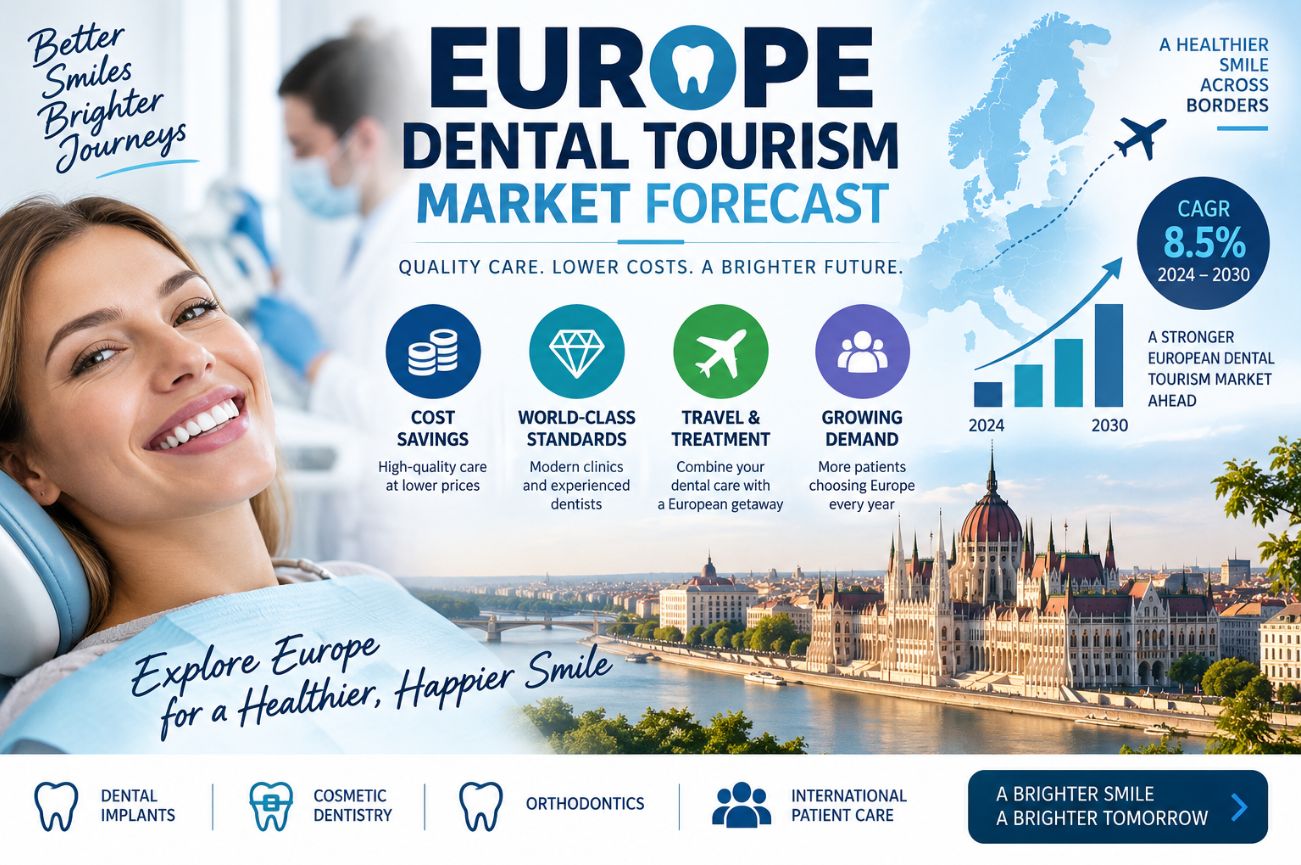
Europe’s dental tourism market is expected to grow rapidly from an estimated US$4.24 billion in 2025 to approximately US$20.25 billion by 2033, with a projected 21.8% compound annual growth rate from 2026 to 2033.
-
Dental implants were the region’s largest revenue-generating treatment category in 2025, while cosmetic dentistry—including veneers, smile design, whitening and aesthetic restorations—is forecast to be the fastest-growing segment.
-
Growth is being driven by high private dental costs in source markets, low-cost European flights, easier online clinic research, an ageing population needing restorative care and rising demand for cosmetic dentistry.
-
Hungary, Poland, the Czech Republic, Croatia, Spain, Italy and other European destinations are competing for international patients, with Budapest remaining one of the best-known dental-tourism cities for UK and Irish travellers.
-
Market growth does not guarantee good treatment. Patients should choose a named, qualified dentist, insist on a tooth-by-tooth written plan, verify materials and implant brands, allow enough time for recovery and confirm aftercare before booking flights.
-
The strongest dental-tourism providers between 2026 and 2033 will be those that prioritise transparent diagnosis, conservative treatment, ethical marketing, traceable materials, realistic travel schedules and long-term patient support—not simply the lowest prices or fastest cosmetic packages.
Europe Dental Tourism Market 2026–2033: Growth, Trends and Patient Priorities
Europe’s dental tourism market is forecast to expand rapidly through 2033, driven by cross-border price differences, demand for implants and cosmetic dentistry, improved travel connectivity, and patients’ growing willingness to compare treatment options internationally. But the headline growth figures should not be mistaken for a guarantee of quality: the market’s future will depend on transparent treatment planning, clinical standards, realistic aftercare and informed patient choice.
Grand View Research projects that Europe’s dental tourism market will grow from US$4.24 billion in 2025 to US$20.25 billion by 2033, representing a forecast compound annual growth rate of 21.8% from 2026 to 2033. Dental implants were the largest revenue-generating service category in 2025, while dental cosmetics are forecast to be the fastest-growing segment.
Europe’s Dental Tourism Market at a Glance
Dental tourism refers to travelling outside one’s home country to receive dental treatment. In Europe, that can mean a UK or Irish patient travelling to Hungary, Poland, Croatia, Spain, Portugal, the Czech Republic or another destination for planned treatment. It can also include Europeans travelling within their own region—for example, an Italian patient going to Hungary, a Spanish resident travelling to Central Europe, or a Scandinavian patient seeking lower-cost restorative dentistry elsewhere in the EU.
The European dental tourism market is not one single, uniform sector. It consists of several overlapping categories:
- Patients seeking lower-cost crowns, bridges, dentures or fillings.
- People travelling for dental implants and implant-supported bridges.
- Cosmetic dentistry patients seeking veneers, whitening, bonding or smile makeovers.
- Orthodontic patients looking for aligners, braces or specialist consultations.
- Diaspora patients combining visits to family with dental care in their country of origin.
- Long-stay residents, retirees and expatriates comparing private treatment options across Europe.
- Patients combining a planned medical or dental appointment with a city break.
According to Grand View Research’s European market outlook, Europe accounted for 28.6% of global dental-tourism revenue in 2025. The publisher expects Europe to be the fastest-growing regional market through the forecast period, although Asia Pacific is projected to lead globally by revenue in 2033.
Those forecasts suggest that dental tourism is moving beyond its earlier image as a niche option for bargain hunters. It is becoming a wider cross-border healthcare market shaped by digital research, low-cost flights, ageing populations, elective cosmetic demand and high out-of-pocket dental costs in many source countries.
The Numbers Behind the Forecast
Grand View Research estimates the European dental-tourism market at US$4,239.4 million in 2025 and projects it to reach US$20,254.7 million by 2033. That represents an increase of just over US$16 billion in annual market revenue over the forecast period.
These are commercial market-research estimates, not official public-health statistics. Forecasts rely on assumptions about travel patterns, patient demand, treatment prices, economic conditions, market definitions and reporting methods. They are useful as indicators of direction and scale, but should be read as projections rather than guarantees.
The most important message is not the precise percentage alone. It is that demand for cross-border dental care is expected to grow much faster than many established healthcare categories. This creates opportunities for clinics and destination cities, but it also raises the stakes around regulation, communication, patient safety and ethical marketing.
Why European Dental Tourism Is Growing
Several forces are likely to support the market’s expansion between 2026 and 2033.
High private dental costs in source markets
For many patients in the UK, Ireland, the United States and parts of Northern Europe, significant restorative dentistry is expensive when paid for privately. Implants, implant-supported bridges, full-mouth rehabilitation, multiple crowns and cosmetic treatment can involve costs that are difficult to manage through routine dental insurance or public systems.
That does not mean treatment abroad is always cheap, nor should it be chosen only because it is cheaper. But the difference in wages, property costs, laboratory expenses, exchange rates and local operating costs can create meaningful price gaps between countries.
For a patient facing several crowns or implants, the decision may be framed not as “local care versus a holiday,” but as “delaying needed treatment versus accessing a structured treatment plan abroad.” This is one reason complex restorative dentistry is such an important revenue driver in the European dental-tourism market.
Low-cost air travel and better connectivity
Europe’s dense network of direct flights, low-cost carriers and short-haul routes makes cross-border dental care more practical than it was two decades ago. A patient can often fly from London, Manchester, Dublin, Edinburgh, Barcelona, Milan, Berlin or Stockholm to Budapest, Kraków, Prague, Zagreb or another dental-tourism destination in a few hours.
Travel accessibility is particularly important for treatments that require two visits. Implant dentistry, for example, may involve surgery, a healing period and a return visit for final crowns or bridges. Lower-cost air routes can make staged care more workable, although patients should still include all travel, accommodation, time-off-work and follow-up costs in their budget.
For clinic operators, flight connectivity can shape where international demand comes from. A city with frequent connections to the UK and Ireland may develop a different patient profile from one that is primarily served by domestic or regional travellers.
Digital patient research and online consultation
Patients increasingly begin their dental-tourism journey online. They compare clinic websites, reviews, before-and-after images, Google Maps profiles, treatment guides, video consultations and social-media content before contacting a clinic.
This digital behaviour has made international dentistry more visible. It has also created risks. A polished Instagram account or a low headline price is not evidence of a sound diagnosis. Responsible clinics need to use digital communication to educate rather than pressure patients.
The strongest online patient journey usually includes:
- A preliminary consultation and request for dental records.
- A clear explanation that an online quote is provisional.
- A full in-person examination before complex treatment is confirmed.
- A written, tooth-by-tooth treatment plan.
- Transparent fees and realistic treatment timing.
- Information about materials, clinicians, risks and aftercare.
- Digital copies of records for the patient to take home.
The market may grow because patients can find providers more easily, but patient trust will depend on whether clinics use that visibility responsibly.
An ageing population and demand for restorative care
Europe’s demographic profile supports demand for restorative dentistry. Older adults are more likely to need crowns, bridges, implant-supported restorations, dentures, periodontal care and replacement treatment for older dental work.
At the same time, patients are retaining more natural teeth into later life than previous generations. This can increase demand for complex maintenance and reconstruction rather than simple extraction and dentures. A person may have several old fillings, root-treated teeth, missing teeth and worn crowns, creating a case that requires careful multidisciplinary planning.
This helps explain why implants were the largest European dental-tourism service category by revenue in 2025, according to the Grand View Research outlook. Implant treatment often involves high-value treatment plans, specialist expertise, laboratory work and multiple appointments.
Cosmetic dentistry and social-media influence
Dental cosmetics are forecast to be the fastest-growing service segment in Europe’s dental-tourism market. This includes procedures such as veneers, bonding, whitening, aesthetic crowns and smile design.
The demand reflects a broader cultural shift. Patients see idealised smiles constantly through social media, celebrity imagery, video calls and photo-led platforms. They are also more willing to view cosmetic dental care as part of wider personal investment in appearance and confidence.
However, the growth of cosmetic dentistry also brings ethical concerns. Smile makeovers are often marketed using simplified terms – “veneers,” “perfect teeth,” “Hollywood smile” or “teeth in a week” – that can hide important clinical distinctions.
A veneer is not the same as a crown. A crown is not automatically appropriate for a healthy tooth. A bright, uniform smile is not necessarily a healthy or durable result. Clinics that want to build a credible international reputation should explain the trade-offs, preserve healthy tooth structure where possible and avoid presenting irreversible treatment as an impulse purchase.
Europe’s Core Dental-Tourism Destinations
The European market includes established dental-tourism countries as well as emerging destinations. Grand View Research identifies Italy, Spain, Poland, the Czech Republic, Hungary and Croatia among the European country markets covered in its outlook. It forecasts Italy as the country with the highest CAGR through 2033.
Hungary and Budapest
Hungary has long been one of Europe’s most recognisable dental-tourism destinations. Budapest in particular combines an established private-dentistry sector with broad air connectivity, a central European location, English-language patient services and a strong city-break appeal.
For UK and Irish patients, Budapest is frequently considered for crowns, bridges, implants, dentures, root canal treatment and cosmetic work. A major advantage is that treatment can be paired with a short stay in a capital city known for thermal baths, Danube views, historic architecture and restaurants.
The risk is that the “dental holiday” label can distract from the medical reality. A responsible Budapest clinic should focus first on diagnosis, treatment planning, infection control, materials, patient consent and follow-up. Travel arrangements should support the care plan—not force the care plan into an unrealistic weekend.
Poland and the Czech Republic
Poland and the Czech Republic are natural options for patients travelling from the UK, Ireland, Germany and Scandinavia. Cities such as Kraków, Warsaw, Wrocław, Prague and Brno offer a mix of dental clinics, city tourism and European air connections.
For some patients, proximity is a deciding factor. A relatively short flight can make return visits more manageable, which is particularly relevant for implant treatment, complex crowns and repairs. However, patients should not assume that a clinic is suitable simply because it is nearby or advertises in English.
Croatia and Southern Europe
Croatia combines dental care with coastal tourism, especially for patients who want to extend a dental trip into a Mediterranean-style holiday. Spain, Portugal, Italy and Greece can attract intra-European patients looking for specific clinics, specialist care, language familiarity or a holiday setting.
Italy is notable in the Grand View Research forecast because it is expected to achieve the highest country-level CAGR in Europe between 2026 and 2033. That may reflect a mix of domestic demand, inbound travel, private-care dynamics and wider medical-tourism activity. It should not be read as a prediction that Italy will automatically be the cheapest or best option for every patient.
Turkey’s place in the wider European market
Turkey is often included in discussions of European dental tourism because it serves a large number of UK and European patients, although Grand View Research categorises Turkey separately in its broader market scope. Turkey’s prominence is driven by aggressive international marketing, package pricing, flight connectivity and strong demand for implants, crowns and cosmetic smile makeovers.
There are highly qualified Turkish dentists and modern clinics. At the same time, the visibility of high-volume, cosmetic-package dentistry has made patient due diligence essential. Potential patients should be cautious of clinics that promise treatment without detailed diagnosis, use “veneer” language for full crowns, pressure patients to accept extensive work quickly or provide unclear aftercare arrangements.
The broader lesson applies to every destination: country reputation is less important than the individual clinician, diagnosis, materials, consent process and continuity of care.
Dental Implants: The Largest Revenue Segment
Implants were Europe’s largest dental-tourism revenue segment in 2025, accounting for a reported 45.08% share of the regional market.
That figure makes commercial sense. Implant cases can involve surgery, CBCT imaging, bone grafting, sinus treatment, temporary restorations, final crowns or bridges, laboratory work and extended follow-up. Full-arch implant rehabilitation can be especially high value, but it is also among the most clinically complex forms of dental tourism.
Patients should understand that implant treatment is not a commodity. An implant is not simply a screw placed in bone. It requires:
- A complete medical and dental history.
- Examination for gum disease, active infection and tooth decay.
- Imaging and planning around bone, nerves and sinuses.
- Consideration of smoking, diabetes, clenching and general health.
- Appropriate implant positioning for the final restoration.
- Sufficient healing before the final tooth or bridge is fitted.
- Ongoing professional maintenance and home hygiene.
“Same-day teeth” can be appropriate for selected patients, but a provisional bridge placed on the day of surgery is not always the same as a finished, fully healed treatment outcome. Patients should know whether they are receiving a temporary or final restoration and when final work is expected.
A clinic should provide an implant passport or comparable record showing the manufacturer, implant system, dimensions and components used. This helps future dentists identify compatible parts if maintenance or repair is needed after the patient returns home.
Dental Cosmetics: Fast Growth, Higher Responsibility
The projected rapid growth of dental cosmetics offers major commercial potential, but it comes with high clinical and reputational responsibility.
Cosmetic dentistry can be conservative and effective. Whitening, orthodontics, composite bonding, gum contouring, minimally invasive veneers and well-designed ceramic restorations can improve appearance and confidence when appropriately planned.
Problems arise when cosmetic treatment is sold as a standardised package rather than a clinical decision. A patient may be offered 16, 20 or 24 crowns without a meaningful explanation of whether every tooth needs coverage. Healthy teeth may be aggressively reduced. Bite problems may be ignored. Gum disease may be left untreated beneath expensive restorations.
For a safer cosmetic dental-tourism experience, patients should request:
- An explanation of every tooth’s diagnosis.
- A written distinction between veneers, crowns, bonding and implants.
- A discussion of alternatives, including no treatment.
- Information about tooth reduction and pulp-risk implications.
- A proposed shade and design process, ideally with a diagnostic mock-up where appropriate.
- Details of the ceramic or composite material.
- Bite assessment and functional planning.
- Written warranty, maintenance and repair information.
The clinics most likely to succeed in the 2026–2033 market will be those that resist one-size-fits-all smile packages and build their brand around long-term outcomes.
Cross-Border Care, Regulation and Patient Rights
Europe has an important structural advantage for cross-border healthcare: many patients travel within the EU or European Economic Area, where formal patient-rights frameworks exist. However, these frameworks do not remove the need for careful planning.
European Commission guidance on planned cross-border healthcare states that eligible patients covered by an EU or EEA national health or statutory insurance scheme may seek healthcare in another EU/EEA country or Switzerland under applicable rules. It also notes that patients are entitled to information needed to make informed choices, including treatment options, prices, qualifications and insurance cover, and to receive a copy of their relevant medical record. Reimbursement rules, prior-authorisation requirements and eligibility vary by country and treatment type.
For private dental tourism, many treatment plans will be self-funded. UK patients also need to remember that the UK is no longer an EU Member State, and they should not assume that EU cross-border reimbursement arrangements apply in the same way as they do to EU-insured patients.
The practical questions remain the same:
- Who is the treating dentist, and what are their qualifications?
- Which professional regulator oversees them?
- Is the clinic appropriately licensed and insured?
- What patient-rights and complaints procedures apply?
- What aftercare is included?
- What records will the patient receive?
- Who pays if a complication requires travel, revision or emergency care?
- Can the patient access follow-up treatment at home?
The UK General Dental Council advises patients considering overseas dental treatment to understand the potential risks, investigate the provider and ensure they know what aftercare will be available.
The Critical Issue: Aftercare
Aftercare is the dividing line between a well-planned international treatment experience and a potentially difficult one.
A crown may need a bite adjustment. A root-treated tooth may flare up. Surgical swelling may last longer than expected. An implant may need monitoring. A bridge may need modification. None of these events automatically means treatment was poor, but they require a clear response plan.
Patients should ask before treatment begins:
- Who should I contact after I return home?
- Is there an emergency line or named coordinator?
- What follow-up can be handled remotely?
- Is a review included before I fly home?
- What happens if I need to return for a repair?
- Does the warranty cover clinical work only, or also flights and accommodation?
- Which records will I be given before departure?
- Can the clinic communicate with my home dentist if required?
TravelHealthPro advises people considering treatment abroad to discuss their plans with a UK dentist, doctor or hospital specialist before booking. It also highlights the need to account for possible complications and the cost of follow-up care in the UK.
For clinics, aftercare is not simply a support service. It is a differentiator. A clinic that clearly explains recovery, stays in contact, provides records quickly and responds constructively to concerns is likely to earn stronger long-term trust than a clinic that concentrates only on lead generation and fast patient turnover.
Risks That Could Slow Market Growth
The forecast is strong, but the European dental-tourism market also faces risks.
Reputation damage from poor outcomes
Public concern around failed cosmetic work, poorly fitted crowns, unnecessary tooth reduction and difficult repair cases can damage trust in the market as a whole. Clinics that use aggressive sales tactics may generate short-term bookings but weaken the credibility of responsible providers.
Rising travel and accommodation costs
Low-cost travel has been an important enabler of dental tourism. If airline capacity, fuel costs, baggage fees, accommodation prices or exchange-rate movements make travel less affordable, some patients may postpone treatment or choose a closer provider.
Regulatory complexity
Cross-border care can involve different rules for professional registration, insurance, consent, consumer rights, advertising and complaint handling. Patients need clearer information, while clinics need robust systems for compliance and record sharing.
Aftercare gaps
A patient’s home dentist may not be willing or able to take responsibility for work carried out abroad. This is especially important for implant complications, complex crowns, full-mouth rehabilitation and cosmetic cases that may require specialist intervention.
Pressure to standardise complex care
Demand growth can encourage clinics to package complex dentistry into fixed-price “smile” products. This may work administratively, but dentistry remains individual. The clinical condition of each tooth, gum, bite and jaw matters. Standardising communication is useful; standardising diagnosis is not.
What a High-Quality Dental-Tourism Model Looks Like
As the market expands, patients should look for providers that offer a quality-first model.
A high-quality clinic should:
- Use a named, appropriately qualified dentist and disclose who performs each stage.
- Take a full medical and dental history.
- Request or create appropriate diagnostic records.
- Confirm major treatment plans after an in-person examination.
- Give tooth-by-tooth recommendations rather than generic packages.
- Explain conservative alternatives.
- Use traceable materials and provide implant documentation where relevant.
- Give transparent, itemised costs and explain potential extras.
- Schedule enough time for laboratory stages, recovery and review.
- Provide written aftercare instructions and a post-treatment contact route.
- Supply copies of X-rays, scans, clinical notes, invoices and guarantees.
- Have a clear complaints process and professional indemnity arrangements.
For patients, the best decision is rarely based on the lowest advertised price. It is based on clinical appropriateness, transparency, travel practicality, communication and the ability to manage long-term maintenance.
Final Outlook for 2026–2033
Europe’s dental-tourism market is projected to become substantially larger by 2033, with demand concentrated in high-value implant treatment and rapidly growing cosmetic dentistry. Grand View Research’s forecast of a rise from US$4.24 billion in 2025 to US$20.25 billion in 2033 reflects a market being reshaped by international mobility, online research, cost pressures and patient demand for accessible elective care.
For UK and US patients, Europe will continue to offer a wide selection of destinations. Hungary, Poland, the Czech Republic, Croatia, Spain, Italy and other countries each have different strengths in travel access, clinic availability, language support, pricing and city-break appeal.
The opportunity is real, but the right approach is cautious and informed. Dental tourism should not be treated as a flash sale or a holiday upgrade. It is healthcare involving permanent decisions about natural teeth, gums, bone and long-term function.
The clinics best positioned for the next phase of Europe’s dental-tourism market will not simply be those with the lowest prices or the loudest social-media advertising. They will be the ones that combine international patient experience with transparent diagnosis, ethical cosmetic dentistry, traceable materials, realistic treatment schedules and reliable aftercare.
Europe Dental Tourism Market FAQs
What is the Europe dental tourism market?
The Europe dental tourism market covers spending by patients who travel across borders for dental care, including dental implants, crowns, bridges, orthodontics, cosmetic dentistry, dentures and other planned treatments. It includes both international visitors coming to Europe and Europeans travelling to another European country for private or eligible cross-border care.
Grand View Research estimates the market generated US$4.239 billion in revenue in 2025 and forecasts it will reach US$20.255 billion by 2033.
How fast is dental tourism growing in Europe?
The Europe dental tourism market is forecast to grow at a compound annual growth rate of 21.8% between 2026 and 2033, according to Grand View Research. The projection suggests that Europe will be the fastest-growing regional dental-tourism market during this period.
Like all commercial market forecasts, this is an estimate rather than a guarantee. Actual growth will be influenced by travel costs, exchange rates, consumer confidence, national regulation, clinic capacity, patient demand and the reputation of the sector.
Why is dental tourism becoming more popular in Europe?
European dental tourism is growing because patients can compare treatment prices, travel options and clinic services more easily than before. Low-cost flights, online consultations, multilingual clinic websites and the ability to combine treatment with a European city break have made international care more accessible.
Demand is also influenced by high out-of-pocket costs for extensive private dentistry in countries such as the UK and Ireland. Patients who need multiple crowns, implants, bridges or full-mouth rehabilitation may compare options abroad when treatment at home is unaffordable or involves long waiting times.
Which dental treatments are most popular with dental tourists?
Dental implants were the largest service segment in Europe’s dental tourism market in 2025, representing 45.08% of regional revenue in Grand View Research’s analysis. Dental cosmetics are forecast to be the fastest-growing segment through 2033.
Common treatments include:
- Single-tooth and full-arch dental implants.
- Implant-supported bridges and dentures.
- Crowns, bridges and replacement restorations.
- Veneers, bonding, whitening and smile-design treatment.
- Root canal treatment and restorative dentistry.
- Orthodontics, including braces and clear aligners.
- Dentures and removable dental prosthetics.
The most suitable treatment depends on the patient’s oral health, gum condition, bone levels, bite, medical history and ability to attend follow-up appointments.
Which countries are important in Europe’s dental tourism market?
Grand View Research’s European market coverage includes Italy, Spain, Poland, the Czech Republic, Hungary and Croatia, with Italy forecast to record the highest country-level CAGR between 2026 and 2033.
Hungary, particularly Budapest, remains one of the best-known destinations for UK and Irish patients seeking private dental treatment abroad. Poland and the Czech Republic are often considered because of their relatively short travel times from the UK, Ireland, Germany and Scandinavia. Croatia, Spain, Portugal and Italy can attract patients who want a combination of dental care and a Mediterranean or city-break experience.
A country’s popularity should not be the deciding factor. The important choice is the individual clinician, clinic standards, diagnosis, materials, treatment plan and aftercare arrangements.
Is dental treatment abroad always cheaper?
Not always. A clinic’s treatment fee may be lower than a comparable private quote in the UK, Ireland or the US because of different operating costs, wages, laboratory prices and local market conditions. However, the real cost of dental tourism includes more than the initial quote.
Patients should budget for flights, accommodation, transfers, meals, diagnostic scans, medication, insurance, time away from work, possible repeat trips, follow-up appointments and any repairs required after returning home.
The lowest advertised package price may not offer the best value if it includes unnecessary treatment, uses untraceable materials or creates costly aftercare problems.
Is it safe to get dental implants abroad?
Dental implants can be safe and successful abroad when they are planned and placed by appropriately qualified professionals, using suitable diagnostic imaging, traceable implant systems and a realistic healing and follow-up schedule. The location alone does not determine quality.
However, implants are surgical and long-term treatments. Patients should be wary of providers that guarantee a result without examining them in person, fail to assess gum disease or bone volume, recommend immediate implants for everyone, or do not identify the implant manufacturer and system.
Before booking, ask who will perform the surgery, what imaging will be used, whether grafting is needed, how long healing will take, whether temporary teeth are being fitted, and whether you will receive an implant passport with full component details.
Why is cosmetic dentistry growing so quickly?
Grand View Research identifies dental cosmetics as the fastest-growing European dental-tourism service segment. Social-media visibility, interest in smile aesthetics, video calls, celebrity culture and the availability of package-based cosmetic treatment all contribute to demand.
Patients should be cautious, however, with generic “Hollywood smile” packages. A cosmetic result should be planned around healthy teeth, gum condition, bite function and long-term maintenance—not only a very white shade or uniform appearance.
Always ask whether the treatment involves veneers, crowns, composite bonding, whitening or implants. These are different procedures with different levels of tooth preparation, cost, risk and permanence.
What should I check before booking dental treatment in Europe?
Before paying a deposit or booking flights, check the treating dentist’s qualifications, professional registration, clinic address, local regulatory status, insurance arrangements and experience with the procedure you need.
The UK General Dental Council recommends that patients ensure they are assessed by a qualified dentist before receiving a treatment plan and price estimate. It also advises asking about the clinician’s qualifications, regulation, success and complication rates, guarantees, insurance, aftercare, complaint procedures and who pays if corrective travel or remedial work becomes necessary.
You should also request a written, tooth-by-tooth plan that explains the diagnosis, proposed procedure, material, total cost, risks, alternatives, treatment duration and follow-up plan.
Do I need an in-person consultation before dental treatment abroad?
For major, irreversible or surgical dentistry, yes. A remote consultation can provide a preliminary estimate, but it should not be the sole basis for final treatment decisions involving implants, multiple crowns, extractions, root canal treatment, bone grafting or full-mouth rehabilitation.
TravelHealthPro says patients should have a face-to-face consultation with the health professional carrying out treatment before any procedure and should have an opportunity to change their mind. It also advises patients not to rely on travel agents, sales representatives or administrators for clinical advice.
A final clinical decision may require dental X-rays, photographs, gum assessment, bite analysis, a review of medical history and, where appropriate, a CBCT scan.
What should a dental treatment plan include?
A credible written treatment plan should clearly identify the teeth being treated and explain why. Ask for tooth numbers or a chart rather than a vague promise of a “full smile makeover.”
It should include:
- Diagnosis and treatment objective for each tooth.
- Procedures proposed, such as crown, veneer, filling, implant, extraction or root canal treatment.
- Proposed materials and relevant implant system information.
- The expected number of appointments and recommended length of stay.
- Itemised fees, deposits, payment schedule and possible additional charges.
- Risks, alternatives and expected lifespan or maintenance needs.
- Details of temporary versus final restorations.
- Aftercare, guarantee and complaint procedures.
- How to contact the clinic after you return home.
Can UK patients use the NHS for follow-up care after dental treatment abroad?
Do not assume that routine follow-up, repairs or revisions of elective dental care arranged abroad will be available through the NHS. Emergency care may be assessed according to clinical need, but ongoing maintenance or corrective work can be difficult to access and may need to be paid for privately.
TravelHealthPro warns that if complications develop after treatment abroad, patients will usually have to pay for care, and that follow-up might not be easily available or covered by the NHS.
Speak with your regular dentist before travelling and include a realistic contingency budget for assessment, repair or specialist care after you return.
Are UK patients protected by European cross-border healthcare rules?
UK patients should not assume that the cross-border healthcare rights and reimbursement arrangements that apply to people insured under EU or EEA systems apply in the same way after the UK’s exit from the EU. Most elective dental tourism arranged privately is self-funded in any event.
Patients insured under an EU or EEA statutory scheme may have rights to seek healthcare in another EU/EEA country or Switzerland, subject to the rules of their insurer, national contact point, prior-authorisation requirements and the type of treatment. The European Commission advises checking eligibility, coverage, reimbursement terms and required authorisation before travelling.
What records should I request before leaving the clinic?
Ask for printed and digital copies of your complete treatment documentation before returning home. This should include consent forms, clinical notes, treatment plan, itemised invoices, X-rays, CBCT scans where relevant, prescriptions, aftercare instructions, laboratory details and guarantee information.
For implant treatment, request an implant passport or equivalent record showing the implant manufacturer, model, dimensions, location and components used. TravelHealthPro specifically advises patients to obtain copies of treatment records, prescriptions, scans and X-rays before leaving their destination.
Does travel insurance cover dental tourism complications?
You should never assume that standard travel insurance covers planned dental treatment abroad. Policies may exclude elective procedures, pre-existing dental problems, treatment-related complications, revision work, extended stays or emergency evacuation related to the planned treatment.
TravelHealthPro recommends comprehensive travel medical insurance, disclosure of planned treatment to the insurer and confirmation that the policy covers complications and medical evacuation.
Ask the insurer for confirmation in writing before you travel, and read all policy exclusions carefully.
What does the future of European dental tourism look like?
The market outlook points to stronger demand for implants, cosmetic treatment and cross-border private care through 2033. Europe’s forecast expansion from US$4.239 billion in 2025 to US$20.255 billion in 2033 will likely encourage more clinics to market internationally.
For patients, more choice should mean better access to information—not less scrutiny. The most reliable providers will be those that combine transparent prices with conservative treatment planning, clear consent, qualified clinicians, traceable materials, realistic travel schedules and dependable long-term aftercare.